Showing posts with label Places to see prints. Show all posts

Tuesday, March 13, 2018

T.M. Fowler's Bird's Eye Views

I recently heard of a wonderful exhibit at the State Museum of Pennsylvania which I am happy to call to everyone's attention. A description of the exhibit is given on the exhibit web site:


‘Every Thing of Interest Shown’: T.M. Fowler’s Bird’s-Eye Views of Pennsylvania, 1885-1905, on exhibit through May 6 on the first floor of The State Museum, showcases a series of bird’s-eye views, or panoramic maps, of Pennsylvania communities as they appeared during the late 19th century.


Urban bird’s eye view of the nineteenth century are one of the most interesting type of American prints there are. Beginning after the Civil War, the bird’s eye view became one of the most popular of print genre, with these prints being made of thousands of American towns and cities from the late 1860s into the early twentieth century. This was a period of significant urban growth throughout the country, and the civic pride which proliferated provided a fertile field for print publishers to market these visual vistas of America. According to John Rep’s seminal Views and Viewmakers of Urban America, publishers sent their artists out into the field throughout all parts of the country to draw and market the views. The artist would walk the streets of the town or city, drawing all the buildings and encouraging the citizens to subscribe to the view that would be produced. Once the entire area was sketched and enough subscriptions obtained, the artist would use a standard projection to turn his street-level images into a bird’s eye view.


Because these views were primarily sold to citizens of the place depicted, they had to be accurate and all buildings shown, lest an owner were to be insulted. The relative size of buildings might be off, some physical features might be exaggerated (for instance the size of a river might be increased to emphasize its importance), or a building not-yet-built might be inserted so the view would not be out-of-date as soon as it was issued, but on the whole the views were amazingly detailed and accurate. Thus these views are not only highly decorative, but are also remarkable historical documentation, providing us with a wonderful documentation of nineteenth century urban America.


Thaddeus Mortimer Fowler (1842-1922) was the most prolific of all American bird’s eye view makers. Fowler served in the Civil War and was wounded at the Battle of Bull Run. That led to a discharge, but Fowler kept involved with the army by making tintypes of soldiers. He later moved to Madison to work for his uncle, a local photographer. Fowler began his career with bird’s eye views about 1868 by working as a subscription and canvassing agent for Albert Ruger of Chicago. Fowler soon came to work also as an artist of the views, making the sketches and preparing the final drawings. By 1870, he set up as his own publisher and from then on he acted as both artist and publisher on many prints, sometimes on his own and sometimes with others.


Over the years, Folwer was involved in over 400 different views! He worked right up to 1922, when at age seventy-nine he slipped on the ice in Middletown, N.Y., where he was undoubtedly promoting a revised view of the city which was planned for that year. Fowler made his first view of Pennsylvania, of Altoona, in 1872, subsequently making more that 240 more views of the Keystone State, more than half of his output. As noted on the State Museum web site, because of this Pennsylvania has more bird’s eye views than any other state.


The State Museum exhibit is well worth visiting by anyone who is interested in bird's eye views or Pennsylvania history. The web site is also excellent, presenting much information and lots of images. The State Museum, along with the Library of Congress, have digitized many of Fowler's prints, shown both in the exhibit and in this blog.


Wednesday, November 18, 2015

Under the Guillotine: Exhibit of caricatures by James Gillray.

A terrific exhibit featuring caricatures by James Gillray will be appearing at the Center for Visual Art at Metro State University of Denver. Curated by Cecily Cullen, the exhibit is drawn from the amazing collection of British caricature prints owned by Professor Arthur N. Gilbert.


James Gillray one of the greatest of political caricaturists and this exhibit is part of the celebration of the 200th anniversary of his death. Gillray (1756-1815) made a name for himself through his witty compositions, capable draftsmanship, and exquisite detail. Through his copious political satires, he set a new standard for the genre, becoming a measure by which his successors were judged. He satirized both British society and royalty and foreign figures. Napoleon particularly attracted his etching needle, and Napoleon one states the Gillray did more to cause his defeat than all the armies of Europe.


Gillray’s caricatures were published as etching, each of which was hand colored, mostly by women whose names are unknown today. They are all delightful simply in their appearance, but well reward careful study. They were sometimes relatively benign, but could also be very pointed and even savage. This exhibit is dedicated to the editor and staff of Charlie Hebdo and it is interesting to contrast today’s society with that of England at the time, where this sort of very intense caricature was so well tolerated.


The exhibit runs from December 18th until March 19th, and other events are planned. More information can be found on the Metro State website.

Wednesday, May 22, 2013

St. Louis Mercantile Library


Earlier this month I attended for the first time the St. Louis Fine Print, Rare Book & Paper Arts Fair. We have exhibited there for all 8 years of its existence, but it was always my partner, Don Cresswell, who attended. This year it made more sense for me to go, which I was pleased about as I had never really spent any time in St. Louis.


It was even more of a pleasant visit than I anticipated, though, for I was totally blown away by the venerable St. Louis Mercantile Library. This is one of the many private libraries (such as the Library Company of Philadelphia and the Cincinnati Mercantile Library) founded in order to provide a library to the community in the era before public libraries were established.


The St. Louis Mercantile Library was founded in 1846 and it is the oldest library west of the Mississippi. It was originally established to be a subscription library "where young men could pass their evenings agreeably and profitably, and thus be protected from the temptations to folly that ever beset unguarded youth in large towns."


The Mercantile Library has moved several times-—it is now housed at the University of Missouri-St. Louis—-and its purpose has changed over the years as well. Today it’s purpose is to serve as a community cultural asset, as a research library, and a repository of its impressive collection which its makes available to local and national users.


The collections concentrate on Western Expansion and the history, development, and growth of the St. Louis region and of the American rail and river transportation experiences, and they encompass a wide variety of objects including rare books, manuscripts, paintings, sculptures, newspapers, drawings, and of course, maps and prints.


To have such a great research resource is terrific, but a visit to the library itself is a real experience. The library is on the lower floors of the university library and the rooms are simply packed with not only shelves and shelves of books, but sculpture, models, paintings, maps, and prints hung in, it seems, every nook and cranny.


My visit for the fair was my first opportunity to visit and I didn’t have nearly enough time, but I wandered about looking at familiar and unfamiliar items with a huge grin on my face. Anyone interested in the Western Expansion would be well served to use this resource, but anyone visiting St. Louis should make it a point to stop by and experience what is, in effect, a twenty-first century version of the enlightenment's cabinets of curiosity.


Thursday, March 8, 2012

With a French Accent

Next week a really interesting print exhibition will open at the Davis Museum at Wellesley College in Massachusetts. Entitled With A French Accent. French and American Lithography Before 1860, it will run from March 14th through June 3rd. On display in the Morelle Lasky Levine '56 Works on Paper Gallery, the exhibition is free and open to the public. 


The exhibition is a joint project between the Davis Museum and the American Antiquarian Society. I have written many times in this blog about the AAS, one of the greatest and oldest American institutions with major collections of prints. The Davis Museum brings its own impressive credentials to this partnership. It is one of the oldest academic fine arts museums in the country, founded in 1889. It has an excellent permanent collection of paintings, sculptures, decorative objects and works on paper, and regularly holds fine exhibitions on many topics, including this new one on prints.


With a French Accent features about fifty French and American prints from the collections of the AAS, exploring the French roots of American lithography. The debt of American lithographs to the British is obvious and seminal, but French prints have had an equally important impact. This is a topic I have been interested in for quite some time (especially as related to the slightly “erotic” Currier & Ives prints based on French sources), so I am greatly looking forward to visiting this exhibition.

It is curated by Georgia Brady Barnhill ’66, Director of the Center for Historic American Visual Culture, and Lauren B. Hewes, Andrew W. Mellon Curator of Graphic Arts, both of the American Antiquarian Society. As they state, the exhibition, and an accompanying publication, “uncover several themes: the importance of French technology, the circulation and reproduction of French imagery, the stylistic contributions of French lithographic artists, and the reproduction of American genre paintings by French publishers for distribution in Europe and the United States." Note that the latter point shows that the influence, at least to some extent, flowed both ways across the Atlantic.

The exhibit opens next week, and I believe the book will be out at about the same time, but of equal interest is the related March 31st symposium, "French and American Lithography: History and Practice," also a free, public event. This will be co-hosted by the Davis Museum and the Center for Historic American Culture at the AAS. The symposium will “explore transnational interconnection, particularly the impact on American lithography of artistic exchange between France and the United States through the 19th and 20th centuries and into contemporary practice."

The symposium will be terrific, but even if you cannot make that, anyone interested in American historical prints should make a point to visit the exhibition at Wesseley.

Friday, March 25, 2011

Visions West, a reprise

Back in January I went to the opening of the exhibition Visions West: 19th Century Expedition Arts at the Arvada Center for the Arts and was so impressed that I had to write a enthusiastic review in this blog. Well, the exhibit is going to be closing in just over a week, so now is the time to visit if you haven't yet!

The exhibition uses prints from the Graham and Barbara Curtis Collection. Mrs. Curtis and her daughter Kay Hunsaker were at the opening and I had the pleasure of meeting them. I asked Kay if she would answer a few questions about her parents and their collection and she kindly agreed.

Tell me a bit more about the collection.

It was my father's passion but my mother was very supportive and in the beginning, she learned to matte so that she could help him frame. The theme of his collection was the artistic documentation of the exploration, discoveries, and development of the American West. The original title he used for the collection was "Manifest Destiny, Exploration and Creation of the Nation."

How and when did your father start collecting?

Dad, a Geologist and hard rock miner at heart, always had a love of the Rocky Mountains, the mineral belt, and the exploration of them. Early on, he read about the West, and as he got older he started collecting antique geology and exploration books.

He then got the idea to share his love of America by giving "educational and enlightening" Bi-Centennial gifts in the form of western exploration lithography. While looking for suitable prints, he realized the extent of the availability, and the real treasures to be had. He found smaller, lesser known pieces of interest but when he found the "Rocky Mountains" by Bierstadt, he realized that famous prints could be obtained and that started his quest.


Were there types of prints or artists which he particularly liked?

Chromolithography is his favorite type, for he liked the bright, clear colors, but hand-tinting will always have a special place in his heart. Audubon's prints were his particular favorites as he always mentions them first, then adds Catlin, Bodmer, Bierstadt, and Moran. In truth, he has always loved birds and became a real "birder" after he acquired these prints.


What are his favorite prints?

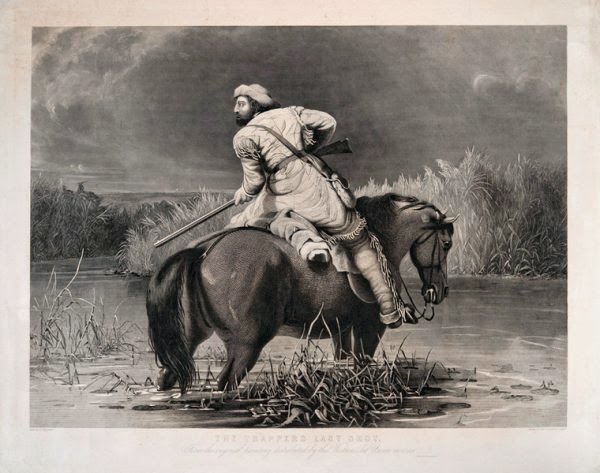
Audubon’s Virginia Partridge and the Male Wild Turkey, George Catlin’s Buffalo, William Ranney’s Trapper's last Shot, Thomas Moran's Grand Canyon, and Albert Bierstadt’s Rocky Mountains.


Was there any print he was looking for a long time and finally got?

The Currier print “The Last War Whoop.” He acquired it just this past August. He had first seen it at the Buckhorn Exchange in Denver, but didn't get it. He quit looking for the print in the last few years but I located it and helped him purchase it.

There is still one he wishes he had gotten and that is the Jolly Flatboat Men by George Caleb Bingham. I found one but it is just too expensive at $15K!

When was the collection first put on display and where else has it been shown?

It was first displayed by the Arvada Art Museum for six weeks in 1986. The museum was pretty new and their staff was small. Dad helped them paint the walls in preparation, Mom and Dad both helped them hang pictures, and assisted in the cost of advertising.

Parts of the collection were also displayed at the Golden, CO Heritage Museum about 1987 & 1988, in the lobby of a bank in Downtown Denver during Denver's Western Heritage awareness, in 1993 or 1996, and in the Littleton Museum twice, in 2006 and 2008.

I wish I had had the opportunity to meet Mr. Curtis, but seeing this super collection in this excellent exhibit did give me a sense of his love and knowledge of the material. Anyone interested in Western prints should make it a point to head over to Arvada to see the collection before it closes on April 3. More information can be found on the Arvada Center's web site.

Thursday, January 27, 2011

Visions West exhibition

From the beginning of the nineteenth century, with the Louisiana Purchase, through the rest of the century, Americans have been fascinated by the trans-Mississippi West. This fascination created a ready market for images of the American frontier, a market that was served by a plethora of artists and printmakers.

I have always been interested in depictions of the American West by those who were early travelers there, an interest which has become particularly keen with my move to Denver. I have begun to delve past those prints which I have studied for years, by artists such as George Catlin, Karl Bodmer, Albert Bierstadt, and Thomas Moran, and learn more about the many other artists who traveled to the West on private and government explorations. Thus it was that I was especially pleased to hear of a new exhibition opening up just a few miles from our shop in Denver on the subject of images of the frontier West.

The exhibit is entitled "Visions West: 19th Century Expedition Artists," and it is running from now until April 3rd at the Arvada Center for the Arts and Humanities. I was able to attend the opening a couple of weeks ago and I was surprised and absolutely delighted at what a tremendous exhibit it is.

The theme of the exhibit is nineteenth century printed images of the American West done by on-the-spot artists. The prints in the exhibit are from the collection of Graham Curtis (about whose collection I will be writing a blog in the near future), which were generously loaned to the Arvada Center by Graham and Barbara Curtis with the help of their daughter Kay Hunsaker. The quality, variety and scope of the prints in the exhibit are amazing, making this an exhibition which anyone interested in the topic has to try to come and view.

The big names--Catlin, Bodmer, Bierstadt, Audubon, Moran--are all there, but the real strength in the exhibit are all the less well known, but equally important artists who documented the West between 1822 and 1883. Some of these artists, such as Seth Eastman, Peter Rindisbacher, and A.E. Mathews, were not part of Government expeditions, but most of the artists whose prints are on display were part of various explorations sent out by the Federal government. These include images by artists such as James W. Abert, John Mix Stanley, Samuel Seymour, John J. Young, Arthur Schott and many more whose accurate, first-hand images provide us with a window on the American West while it was still a "wild frontier."

The exhibition in Arvada is very nicely presented. The prints are arranged by artist, rather than date, and this allows one to look at some of these familiar prints from a new perspective, focusing on the artists, not so much the expeditions. The staff has written informative text on each artist and his work, and so the exhibit is a feast for the mind as well as the eye. All involved should be proud of this wonderful exhibit and again I encourage anyone who can to stop by to see the exhibit before it closes on April 3rd.

Wednesday, December 22, 2010

Denver Public Library

Last week I attended a breakfast meeting at the Denver Public Library about their new Creating Communities project. This is a terrific program which is designed to make the historical resources of the library, as well as those from other affiliated institutions, accessible to the general public through the Creating Communities web site. As a die-hard believer in the use of historical material to promote knowledge and understanding of our past, and so also of our present, I was delighted to find out about this program.

First a word about the Denver Public Library. Until this summer, I lived for the last three decades in Philadelphia, which has one of the oldest and best public library systems in the country, so I was very pleased to find that the Denver library system is also absolutely first rate. The library was established in 1889, the city librarian calling it a “center of public happiness.” In 1910, a new Central Library building was constructed, and then over the next decade eight branch libraries were built, all with the generous help of Andrew Carnegie. As the library system matured, new branches were opened, old ones refurbished, and in 1995 an outstanding new Central Library was built, designed by Michael Graves.

I am a fan not only of libraries, but also of institutions which hold collections of prints & maps. It turns out that in Denver the public library is the institution in this area with the best collection of historic printed images, a collection held in the Western History and Genealogy department. Their collection of Western Americana is, without question, one of the best in the country.

Opened in 1935, the Western collection was initially intended to focus on books by Colorado authors, but soon the department broadened its focus to encompasses all phases of the development of the trans-Mississippi West. To quote the library web site, “[t]he collection continues to grow and presently includes 200,000 cataloged books, pamphlets, atlases, maps, and microfilm titles. In addition, it offers 600,000 photographs, 3,700 manuscript archives, and a remarkable collection of Western fine art and prints to researchers across the world.”

Among the collections in which the library is particularly strong are publications of Western railroads, reports and maps of Colorado mining companies, trade catalogs, records and printed memorabilia of Buffalo Bill's Wild West shows, frontier theater programs, land grant materials, Colorado territorial imprints, architectural drawings, and extensive clipping files of local newspapers. The maps and atlases, of which there are about 6,000, and the historical views are, of course, of particular interest to me. The Western Collection is a place I plan to spend much time researching.

As with any library, one of the main goals of the Denver Public Library is to reach out to the community, both to provide it with access to its resources, but also to stimulate curiosity and increase knowledge. That is what Creating Communities does. Other local institutions are also involved in the project, including the City of Denver, History Colorado, the Auraria Library, the University of Colorado at Denver, and the University of Denver Penrose Library. This program makes available on the web many of the resources about Denver and its history from these institutions. One of the main parts of the web site is a section with information on seven of Denver’s historic neighborhoods, and many of the Western Collection’s archival materials, in digital form, are also available through the site, including property maps of the city.

An interesting part of the program is “myDenver”, which is designed to allow the general public to upload photographs and stories of their own, and to be part of an ongoing conversation about their city. The further development of myDenver is one of the main goals of the Creating Communities program going forward.

I was rather spoiled by the extensive institutional riches of Philadelphia and I was a bit concerned in moving to “the West,” that I would be bereft of this important type of resource. I was, as I should have known, mistaken in this, for Denver not only has its own rich history (though not as long a one as Philadelphia) but also its own wealth of historical material which available to me and to anyone else with an interest in the history of this wonderful city.

Thursday, September 30, 2010

Philadelphia Print Shop West

Despite my best intentions, I have just been too swamped with all the things involved in setting up the new shop in Denver to be able to write any blog postings. Next week I should be able to get have a print related post, but just to get something up, I'll give a brief report on my efforts here in Denver.


We got into our new space at the beginning of September. It is a terrific space located in the Cherry Creek North section of Denver (2819 E. 2nd Ave). The previous tenant left their "slat wall" system, which isn't really our "ye olde printe shoppe" style, but it is very versatile and will work fine.


The first week or so I had to clean out the stuff that was left, get some furniture in the shop, get the walls painted, etc. etc. Then Jon arrived with the initial shipment of inventory from Philadelphia. Jon had taken our "Denver" inventory to an antique show in Minneapolis and then drove on to Denver. Long drive for Jon, but now I have inventory!

The next few weeks will involve getting print racks, plan files, unpacking and getting things ready for our grand opening. As I will be exhibiting at the San Francisco Antiques Show in late October, our grand opening won't be until November 13th. If anyone is in the Denver area, I hope you will stop by! Or if anyone has any questions about the new shop, feel free to call the new shop number at (303) 322-4757.

Thursday, June 10, 2010

Denver Here We Come!

My blogs have slowed down considerably since I was doing two a week until fairly recently. I have not even quite managed once a week, which is my current goal. There are a number of reasons for this, including presenting a paper at the recent AHPCS conference (that conference is the subject of my next blog, which I hope to get up soon), and the BIG NEWS, which is that I am moving to Denver!
My wife has accepted a terrific job offer from Denver Childrens Hospital and I am tagging along for the ride. Since I have too much fun in this business and with the Print Shop to do anything else, we are going to open a branch in Denver, "The Philadelphia Print Shop (West)." We should be opening sometime in the autumn and plan to locate in Cherry Creek North, which is a very nice shopping district in the city of Denver, not too dissimilar to where we are located in Philadelphia. Our shop in Chestnut Hill will, of course, remain as our primary location, but I'll be taking a good variety of material to Denver with an emphasis, naturally, on western material.
Denver is a wonderful city and my wife and I are really looking forward to the adventure of moving away from the East Coast. I hope anyone from that part of the country will come by and visit. We'll be making a more formal announcement once we have the shop opened, but if I am a bit tardy in posting my blogs, at least now you'll know why!

Thursday, April 15, 2010

Philadelphia On Stone

I seem to be a bit behind once again on posting about a terrific print exhibit, Philadelphia on Stone, which opened last month... I did mention that this exhibition was coming when I posted a blog on The Library Company of Philadelphia, but forgot to make a new post once the exhibit actually opened. My forgetfulness has nothing to do with what I think of the exhibit, for I think this is one of the best exhibits on 19th century American lithographs I have ever visited.

The exhibit Philadelphia on Stone: The First Fifty Years of Commercial Lithography, 1828-1878 focuses on 19th century Philadelphia lithography. Invented at the end of the 18th century, commercial lithography only came to America in the 1820s, becoming the dominate means of printmaking by the time of the Centennial. As clearly documented in this exhibit, Philadelphia played a seminal role in the development and expansion of American lithography, from the first American lithograph by Bass Otis in 1819 to the commercial advertisements of the 1870s.

The exhibit is in the Library Company's quite small exhibit space, but curator Erika Piola has done an terrific job of packing in an amazing amount of information, along with lots of wonderful illustrations and examples of Philadelphia lithography. The exhibit considers a number of different aspects of Philadelphia lithography. A clear and quite comprehensive section focuses on the history and process of the medium and another interesting section looks at the lives of Philadelphia lithographers. The examples of Philadelphia lithography, from the Library Company holdings and other collections, are varied, attractive, colorful and fascinating.

This exhibit is part of a larger collaborative project headed by the Library Company, under the direction of Erika. Besides this exhibit, the Philadelphia on Stone project is embarked on making a survey of eight institutional collections--the Library Company, Historical Society of Pennsylvania, the Atwater Kent Museum, the Athenaeum of Philadelphia, the Free Library of Philadelphia, the American Antiquarian Society, the Library of Congress, and the Smithsonian Institution--for lithographic views of Philadelphia in this period. This survey will soon result in a digital catalog, available on-line, of these prints. Other parts of the project include a biographical dictionary of Philadelphia lithographers and a forthcoming book on the subject (for which I have contributed a chapter). For more information on this project, and to access the digital resources as they become available, visit the Philadelphia On Stone web site.

Let me once again highly recommend visiting the exhibit, which is running through October 15, 2010. It is visually captivating and intellectually stimulating. I consider myself something of an expert on the topic, but I learned an amazing amount as I went around the exhibit. In the last decade or so, there have been more and more scholarly projects on the history of American prints and this exhibit, and the related project, are superb examples of this exciting trend.