Showing posts with label Economy of prints. Show all posts

Wednesday, June 26, 2019

Selling plate books by subscription

From the early days of printed book production, in the 17th century, expensive and/or long publications were often initially sold in parts or fascicles. The fascicles were simply a part of the larger work, where the cost to purchase was less so that the buyer could eventually buy the entire book in installments and the publisher would get money as the book was produced, not having to pay for the entire production cost at the beginning.


This method of production also had the advantage to the publisher that if the book proved to not be of interest to the public, with subscriptions not be obtained in sufficient number, only a minimum amount was spent before the project was abandoned. Some of these plate books never got off the ground and others lost subscribers over time, so that the books were never completed. An example of this is James Otto Lewis’ Aboriginal Portfolio. Lewis originally intended to issue ten parts with eight prints in each, but he was unable to obtain enough subscribers so that only a very few sample prints from the tenth part were ever made.


This method of producing books was particularly important for plate books, where the cost of creating the matrixes, printing the plates, and then often coloring them was substantial. The publisher would start by producing a first part on speculation, using the completed fascicle as a sample to help obtain subscribers for the work. Once he had enough subscribers signing up and paying for the first part, that money was then used to produce the next fascicle, and so on until the publication was completed. The importance of the subscribers is shown by the fact that Thomas McKenney included a facsimile of his subscriber list in his bound History, an image of which is above.


These fascicles were usually produced with paper covers which included information on the book, often including a sales pitch to keep the subscriber interested and to help gain new subscribers.


Once finished, the subscriber would usually have the parts bound together and the publisher could also sell completed copies of the book, using the plates and text that had been printed beyond those needed just for the subscribers.


One of the pioneers of this sort of plate book sold by subscription was Mark Catesby. He produced his Natural History of Carolina, Florida and the Bahama Islands between 1731 and 1743, issued in parts for over a decade. The spread of dates for this book are a result of the subscription process, and this was typical of plates books produced in this manner.


Most elaborate plate books of the nineteenth century were sold by subscription, including Alexander Wilson’s American Ornithology, Thomas McKenney’s History of the Indian Tribes of North America, and even the mammoth Birds of America by John James Audubon.


Occasionally one will come across the original fascicles of these books which were never bound together. In these instances either the subscriber dropped out before the work was finished, or he/she simply didn’t bother bind them even when complete. Other times subscribers would keep the paper covers and bind them together with the text and plates.


Wednesday, January 2, 2019

Drop in prices of antiques since 2000

A number of months ago, Antiques Roadshow broadcast one of their "vintage" shows, this one showing appraisals from Birmingham in 1999. That was from only the third year of the show, the second year in which I appeared as a print and map appraiser. Watching it, the first thing that I noticed was how young everyone looked. A fair number of the appraisers who appeared in this episode are still appraising for ARS and everyone looked so much younger (of course, I haven't aged a bit...)


The second thing I noticed was how about 3/4's of items had current values below (and often well below) the original appraised values. The show initially puts up the original appraised value, and then after a pause (to let you guess which way the value has gone), they post the current appraised value. In the vintage Birmingham show, from almost twenty years ago, only a couple current values were higher than the original values and just a few were the same. By far most of the new values were below the original appraisals. So what does that mean?


This reflects the fact that, as a general rule, antiques have gone down in value since the turn of the millennium. Part of that is because in the last decade of the twentieth century, prices for antiques were quite strong. Antique shows were going strong, decorators were keen on using antiques in homes and even offices, and there were lots of established and new collectors seeking out the best antiques of all sorts.


In general, it was for the "top end" antiques that prices were steadily going up, the "low end" rising a bit, but really not that much. The advent of Antiques Roadshow reflected the popularity of antiques at the time and also helped to sustain the rise in interest and prices. Of course, in general the appraisals which were shown on ARS were for "top end" items, so combining that with high prices of the time means that the appraisals reflected the booming antiques market.


Then, of course, along came 2008 and the great economic crash. Many parts of the American economy were hurt by this, including antiques. In most cases, the purchase of an antique is a luxury or discretionary purchase, and this was the type of purchase that was most hurt after 2008. Auction and retail sales in antiques slowed dramatically. Auction prices dropped quickly, but this did not lead to an immediate drop in retail prices. Many dealers tried to hang on to the "old" pricing structure, though they were certainly much more amenable to giving a discount. Over time, however, it did definitely lead to a lowering of many prices in the antiques world. I would say that by about 2010-12, a pricing structure for antiques had become pretty standard.


In the last few years, in some areas of the antiques market, there has been some rise in prices, though we certainly have not reached the hey-day of 1999. People are much more likely to spend their discretionary dollars on things like antiques, so we have come out of the really dark days of 2008-2010. The market, though, is quite different. Few prices are reaching new heights, and some areas of antiques which used to be "hot" are no longer so.


I think probably the biggest reason for that is the lack of serious collectors. Back when the Birmingham appraisals were filmed, there were lots of collectors--some long-term, some new collectors--seeking out the best items in many areas of antiques. In my field, collectors of the best natural history prints, prints of Native Americans, Currier & Ives lithographs, and maps were steadily driving prices to new heights. The economic disaster of 2008 knocked most of these collectors out of the market, and frankly, few have come back in even a decade later.


Why is that? I suspect that some of it was that the most of the long-term collectors were not that young, and after they stopped collecting in 2008, they just never had the enthusiasm to restart. It is one thing to gear up for collecting when one is 30 or 40, but another thing when one is 60-70. Adding to the problem is the fact that there just are not that many young collectors entering the market. Whether that is a product of changing interior design styles, a lack of appreciation of "things," or just lack of education about antiques, everyone in the antiques world will tell you that there are not many millennials or other young people purchasing antiques.


Do I think prices will come back? I think eventually for the best of all types of antiques. Antiques are wonderful artifacts of our past which still can play a relevant role in our lives, even if just as furniture, decoration or whatever. If one looks at the prices for a really well-made antique compared to a mass produced modern equivalent, the antiques are often better value just as objects. When one factors in their history and scarcity, they have a huge appeal. Markets do tend to go up and down and I think the antiques market will go back up. How soon, I wish I knew. The continued popularity of Antiques Roadshow, however, is a hopeful sign.


Tuesday, July 17, 2018

Price ranges within series of prints

About two centuries ago, Thomas McKenney, the head of the United States Bureau of Indian Affairs, began to commission portraits of Native Americans both when they visited Washington D.C. and from artists “in the field.” McKenney realized that the “progress” of American culture threatened to wipe out the Indian cultures and he felt it was important to document the individuals and their culture for posterity.


When he left office in 1830, McKenney decided to try to produce a portfolio of lithographs based on the paintings he had gather for the government. He borrowed the paintings, had copies made, and then arranged for the production of the images as hand colored lithographs. After many years of battling poverty, politicians and printers, a portfolio, History of the Indian Tribes of North America, was published with 117 portraits and three scenes (actually 118 portrait prints were produced, but one was never included in the portfolio).


The portraits were all based on life paintings, showing many of the Native America chief from around the country, as well as some lesser individuals and women. These paintings provided an incredibly important documentation of Americans from the period, showing not only their faces, but also their dress and accouterments. Although McKenney was acutely aware that he was preserving a chapter in history, he could not have known that had he not undertaken this project, no record at all would remain, for in 1865, a fire at the Smithsonian destroyed almost all the original paintings from which the lithographs were drawn.


In any case, the prints from McKenney's portfolio all share the same history, they have the same relevance to our past, they are all the same size, and they were done by the same printers and lithographers. However, they sell for a wide range of prices. The most expensive prints in this series sell for over $3,000, whereas there are a number that are generally priced at $300 or less. We had a client in the shop the other day, and he was quite puzzled why there was such a range of prices (of course, he liked the more expensive ones and wanted them to be priced closer to the cost of the less expensive ones).


Thus it seemed that a blog explaining why there was such a variation in prices for the prints within one series would be useful, for this type of variation occurs with lots of different series of prints, not just the McKenney portraits. It happens with most natural history prints, and probably the extreme example are the first edition, Audubon bird prints. Some of the prints from that series sell for over $100,000, which others sell for just a few thousand dollars!


The bottom line is that there is often a variation in prices within a single series of prints based purely on desirability of the prints with the public. The prints in one series tend to have equal, general historic value and quality of production, but that doesn’t mean that the public has equal interest in all of them. Sometimes there is a variation in the specific historic import of a particular print (for instance, in general prints of extinct birds sell for more than the ones of birds which are still around today), sometimes there can be prints which have a particular appeal to the public (for instance, prints of dogs and cats tend to be more popular than prints of aardvarks and mice), but the most common reason is appearance.


Within most series, some of the prints are just more visually attractive than others. It can be size (the larger birds from the Audubon series sell for more than the smaller birds), it can be color (a print of a Cardinal will sell for more than a Wren), or it can just be the prettiness of one image compared to the other.


When a print dealer sets prices for the individual prints within a series, he/she will line them up in order of what he/she thinks how their appeal compares to the others. The print market will generally set the value range of a series (so, for instance, first edition Mark Catesby prints will sell for a range between about $7,000 and $700) and each dealer will then assign his/her prints to a place within that range. It is interesting that different dealers will assign different prices to prints depending on their reading of the market, though the ranges for most dealers will be consistent.


This, of course, makes total market sense as the more desirable prints can be sold for more, while one sometimes has to really cut prices on some of the less desirable prints in order to sell them at all. Typically, despite what can be a very large variation in prices, it is the more expensive prints which tend to sell more quickly than the less expensive ones. An interestingly phenomenon is that as dealers get different groups of prints from one series over time, they will sell the more expensive prints, while the lower end tend not to sell, resulting in many dealers have few of the “better” prints, but often multiple copies of the “lesser” prints.


So, how does this play out for the McKenney prints... The most important factor in desirability is the print's appearance. Some of the Indians are spectacular, with strong colors and fierce aspects, while others look like they are refugees from an immigrant camp. Looking at the two prints above, it is not hard to see which would sell for more, and would still be easier to sell at that higher price.


There are two other aspects to the visual premium besides just appearance. There are a few prints in the McKenney series which show full figured Indians, while most are just bust portraits. Being a full figure adds a price premium. Then there is the premium for having regalia or accessories which are of interest. There is only one of the figures with the archetypal full feathered headdress, only one figure with the classic bow & arrow, and a few with interesting weapons, robes or necklaces. All of these are worth more than they would have been without those accouterments.


Two other factors in the valuation of McKenney portraits relate to the history of the particular individual depicted. Some tribes are more desirable than others, for various reasons; there are only two portraits of the romantic Pawnee tribe, the Seminoles and Creeks remain of great interest in the American southeast, and the Iroquois appeal to many in the mid-Atlantic region. Other tribes have much more passed into the historical shadows, such as the Chippewa.


More important is who the individual is, for there are a number of portraits of Native Americans who are of particular interest or importance in American history. Portraits of Pocahontas, Red Jacket, McIntosh, and Black Hawk sell for more because of who they show, not particularly because of their appearance.


So at the top of the price list, one would find a magnificent portrait of a full-figured chief of great importance; that is Osceola. At the other end of the range you will find a rather pathetic portrait of an emaciated chief from a tribe which excites little interest about whom no one knows very much; that is Waemboeshkaa. These prints share a history and quality of production, but it is really not surprising that the one is worth over ten times the other. If you look at our listing of McKenney folio prints in price order, one can see all these factors played out; one might disagree on our particular ranking, but it should make sense.


Tuesday, April 3, 2018

John E Dillingham

By the middle of the nineteenth century, lithographic publishers were popping up around the country and this provided a new outlet for the artistic and commercial interests of American artists. Without a huge investment, artists could have their images turned into prints and sold to the public and many took advantage of this opportunity. Some of these prints were sponsored by the publishers, some by the artists themselves, and some jointly, but in all cases, it was hoped that these lithographs would sell well, producing profit for all involved.


One artist who tried to career path was a Connecticut born artist named John E. Dillingham. Trained as an accountant, Dillingham moved to Chicago about 1852, where he branched out a bit, being listed also as an artist, designer or writer in the city directories. In the March 1857 issue of Chicago Magazine two prints of Fort Dearborn appeared for which Dillingham made the drawing on the wood blocks.


At some point, Dillingham decided to throw his hat completely into the artistic ring, heading out to the region of the Pikes Peak Gold Rush, today's Colorado, and trying his hand at painting local scenes. He may have come with the intent of making sketches for eastern newspapers or magazines, though none are known to have been published. Dillingham traveled around the Front Range trying to sell his work to local businessmen and citizens. At some point he hooked up with John J. Pratt and Bela S. Buell, two local engineers and surveyors, who had been planning to issue a large map of the Colorado gold fields since late 1860.


When their map appeared in 1862, it included 27 images around the sides. Twenty of these are images of buildings in Colorado, mostly businesses and one private residence. Most, if not all, of these were based on photographs. These illustrations were paid for by the building owners as promotion for their business or simple prestige.


Besides the twenty building vignettes based on photographs, there are seven scenes of Colorado. These were intended in part to help to give an idea of the terrain of the territory, but they were also for sale as separate prints. Four of the images are attributed to a specific artist and the other three are unattributed. The view of Bear Creek Valley gives the artist’s name as “F.M. Case,” that is Francis M. Case, the first Surveyor General of Colorado. As part of his survey work, Case would need to have be able to make drawings of the land to accompany his reports. Case’s image is reasonable, but relatively crude. This matches the style of the three unattributed views on the map, which leads me to think they may also have been drawn by Case. The last three views of Colorado are attributed to Dillingham, and they are of better quality than all the other views.


The first image is a small oval at top which shows Camp Weld. This was built in 1861 so that Colorado could raise and train troops for the defense of the Union.


A bigger scene shows the mining town of Central City.


The largest image was at the bottom, a panoramic view of Denver, drawn from a location then just outside of town, today where the state capitol is located.


Dillingham, as an enterprising and hopeful artist, did not simply have his images used as illustrations on the map, but also had them issued as separate lithographs for sale to the public. It does not appear that this effort was that successful, as only two examples are known of his separate print of Denver.


The fluid nature of the market for prints at the time is demonstrated by another image by Dillingham. The first edition of the Pratt and Buell map had only the three illustrations by Dillingham, but a variant edition of the map added a fourth. In place of a building picture and a general view in the top left corner of the map, a new image of "Bob Tail Hill" was put in their place. There had to be some reason this change was made and it likely was a commercial one. It is possible that the owners of the mines shown on Bob Tail Hill paid extra to have the image added, or perhaps Dillingham instigated the change so that he could market a new print. This latter notion gets some support from that fact that this view of Bob Tail Hill was sold as a separate print.


At about the time as he produced the print of Bob Tail Hill, Dillingham was working on another picture of the essentially the same area. This image was never intended for a map illustration, but rather specifically to be sold as a separate lithographic print. In January 1863, a large lithographed view of Black Hawk drawn by Dillingham was lithographed by Charles Shober of Chicago. By March 12, 1863, a local paper was advertising this print as being sold by subscription, and the next month Dillingham announced that he was heading back east to try to find additional subscribers there.


The print shows Black Hawk as a booming community, with many prosperous, well-dressed citizens shown peacefully congregating around the town—-including one woman on a horse and another woman and child pair. Note that many of the businesses have their name displayed on their building. This was a way in which Dillingham could make some money on his print besides simply selling subscriptions. Dillingham would offer to display a business’s name for a fee, and if you didn’t pay the fee, you didn’t get your name in the print.


This was not the only supplemental way in which Dillingham was able to get money for this particular print, an interesting story detailed in a Colorado state resolution. On the 1862 Pratt & Buell map of the gold regions, the name of the small community just east of Central City was listed as “Enterprise.” Supposedly three local mill owners, William Lee—-proprietor of the Black Hawk Mill, Fredrick H. Judd—-owner of the Eagle Mill, and Mylo Lee-—who owned the Tiger Mill, all wanted the town to be named Black Hawk Point. So, they are said to have commissioned Dillingham to produce this print with their preferred name prominently in the title. This story is confirmed by the crest in the bottom margin, which contains symbols representing their three mills; the Eagle, Black Hawk and Tiger.


Despite all the ways he tried to make money with his drawings-—by having them used as map illustrations, marketing the prints by subscription, selling naming rights, and getting commissions-—Dillingham does not appear to ultimately have been successful. The last we definitely hear of him is in April 1863, shortly after the Black Hawk print was published, when he announced he would be heading back “for a short trip East” in order to sell subscriptions. He isn’t mentioned again in Colorado, though appearing back in Chicago directories as an artist.


Thursday, August 4, 2016

Along with the regular Antiques Roadshow programs, which show the Roadshow stops from the previous summer, the program has been airing a series of "Vintage" shows, which rerun selected appraisals from the past. For each rerun appraisal, the folks at WGBH contact the original appraiser to see how the appraised value might have changed. Recently I got an email from the produces asking me about a map of the Mississippi River I appraised back in 2001 for between $4,500 and $5,000.


Now this sort of map is just the sort of map which has become "hot" in the last decade or so, so when they asked me for a value, I knew it would have gone up, but I figured that just to be sure I would do some digging to see if there was a recent price record on it. Boy am I glad I did! The map had sold at an auction in 2009 for $300,000! As this was such a big jump, I thought it would be worthwhile writing up a posting explaining why I thought this had happened. This blog is a copy of that article. The original appraisal and the article can be seen on the Antiques Roadshow web site. The article follows:


For a map to increase in value about 30 times in 15 years is a huge jump and the reasons for this are quite interesting. Some of it has to do with a change in the market and some with what I call "auction fever."


When I first got into the business of selling maps back in 1981, most collectors were looking for maps from the earliest days of printed cartography, particularly the beautiful Dutch maps from about 1570 to 1650. These were from the Age of Discovery and the maps had beautiful engraving, rich hand color, and lots of fun features such as sail ships, elaborate compass roses, and even sea monsters.


One of the biggest changes in the attitude of map collectors since those early days has been shifting their focus from the decorative appeal of maps to their historical significance. The latter factor has always been important for collectors, but in the late 20th century, collectors became more enamored with maps that focused on specific information about particular events in history — such as the first map to show the City of New Orleans, or a contemporary map of the American Revolution — even when those maps did not have a lot of color and their decoration was limited to their cartouches.


At the beginning of the present millennium, it was 17th- and 18th-century maps that were particularly sought after by collectors, and so were increasing significantly in value. In the years since then, collectors have begun to turn more and more to 19th-century maps — especially those that have some intriguingly direct connection with history. As the 2000s progressed, it was maps like the first to show a rebuilt Chicago, or one showing the results of a seminal exploring expedition to the American West, or a folding map of a newly built railroad, which became more and more sought after and thus more and more valuable.


The Norman 1858 map of the lower Mississippi River is a perfect example of the type of map which has become ‘hot’ in the last decade or so. It has an immediate connection with the history of the boom years of the plantations along the Mississippi — the artist, Marie Adrien Persac, traveling between New Orleans and Natchez on a skiff and recording all the plantations and landmarks he saw along the way. There really could not be a more significant historical document of this region in that period than this map. Combined with the fact that it was a separately issued map — extremely rare today — means that when the ROADSHOW producers asked me for an updated value while preparing the Vintage New Orleans show this spring, I knew it would have gone up a lot since 2001.


My initial reaction was that its current retail value would probably be somewhere between about $20,000 and $30,000, quite a big jump from my valuation of $4,500 to $5,000 in 2001. However, given the way this sort of map had risen so much in demand, I thought I ought to do some further digging to find out if any had come on the market recently.


And am I ever glad I checked. One had indeed come up for auction at the end of 2009 and sold for a huge price! The auction house’s estimate, $18,000 to $25,000, was similar to my initial thinking about this map’s current value — but when the bidding had finished in that 2009 auction, the map cost the buyer $316,000!


There are few American maps that have ever brought that amount, and though the Norman map is special, particularly for that region, to pay over $300,000 for it seems excessive. I can find no similar map for any other region of the United States that has ever sold for so much. So why did it go for so much? My guess is simple "auction fever." Auction bidders with deep pockets sometimes have large egos that lead them to believe if they really want something then they must win it no matter who else might bid against them. If you get two or more such bidders for the same item, those egos can sometimes override any prudent financial sense, leading to prices well above what would be considered a reasonable value. I think something like that may have happened for this map.


So, that brings up the question of what I think this map’s “real” value might be today, having appraised it for $4,500 to $5,000 in 2001. Certainly, the 2009 auction means that my initial thought of $20,000 to $30,000 is too low, but I do not believe that in any other circumstances — without the heat of auction fever — this map would bring over $300,000 again. Still, any potential buyer looking at that auction record would realize he or she would have to pay well above $30,000 for it. So I think that if this map appeared in a retail setting, it would probably be listed somewhere between $150,000 and $200,000. If it came up at auction and bidders were able to keep their egos in check, it might bring half to two-thirds of that price. But then again, fever could strike again at any time!


Wednesday, April 6, 2011

Value of Frames

Most people who have antique prints have them in frames and many of the prints you run into at auction or in shops are framed. My focus is always on the value of the prints themselves, but surely the frames for these prints add value to the prints, right? Well, that question is actually fairly complex.

First off, as a rule our shop does not usually add any cost onto a print we have framed versus one that is unframed. So if we happen to have two examples of the same print, one framed and one unframed, they will usually be priced the same way. The main reason for this is that a lot of times someone wants a print that is in a frame but doesn't want the frame. If we added on for the value of the frame, then we would be obliged to knock off that cost if we sold the print unframed and we would end up with an empty frame that was not of a lot of use to us. The way we do it, you can take the print in the frame or out of the frame for the same price, and most people take the print framed and so we are not left with a lot of empty, relatively useless frames.

There are, of course, exceptions to this. If the frame is a really nice "period" frame (perhaps original) or if the frame is particularly wonderful (like the tramp art frame on our Custer's Last Stand print), then we do add onto the price of the print. However, this is the exception rather than the rule.

What this means is that we also do not pay extra for the frames when we buy the items. A number of people will bring us a print and expect to get extra for their frame, but as we won't charge more, we won't pay more. We also tell people they are welcome to keep their frames, but usually the people selling just want to get rid of the whole thing.

This can be very disappointing to people and it seems like it is unfair. As anyone who has had a print framed in the last decade or so knows, framing (especially museum standard framing) is very expensive. The frame for a moderately priced print is often more than the print itself, so how can it be that when you go to sell the print in the frame, you get nothing for the frame?

Well, there is a big difference between buying something "as is" and going out and having something made exactly as you want. If you are selling a print in a frame, the potential buyer has to take that frame or nothing. It is likely not the style, size, color or whatever they might have chosen; it just is what it is. People will usually not pay as much for something like that both because it probably isn't exactly what they want but also because it is a take-it-of-leave-it fait accompli. If someone is ordering a frame, they get just want they want and are having someone make it specially for them. It is much like buying an off-the-rack jacket vs. having a tailor make one specially for you. An existing frame just doesn't have that much value to buyers in the market.

And there is the other issue of whether the framing is "museum quality." A large majority of the antique prints framed today are in frames that are actually causing them harm (this is discussed in another blog). Not only is a buyer of such prints getting a frame that they didn't choose, but the frame needs to be taken apart and put back together to preserve the print.

Now it is true, as I said above, that there are frames which do add to the value of prints, but generally it is wise not to pay extra for a frame. If you really like the frame, ok, but it is also important to see if the framing is museum quality, for if it is not, you will be adding quite a bit of expense to the cost of the print (assuming you want to preserve it) and need to factor that in. There are actually a lot of cases where the framing can actually cause the print to be worth less! And finally, if you are looking to sell framed prints, don't expect to get extra for the frames. It just isn't the way things work.

Friday, December 10, 2010

Audubon's Birds of America sets record price

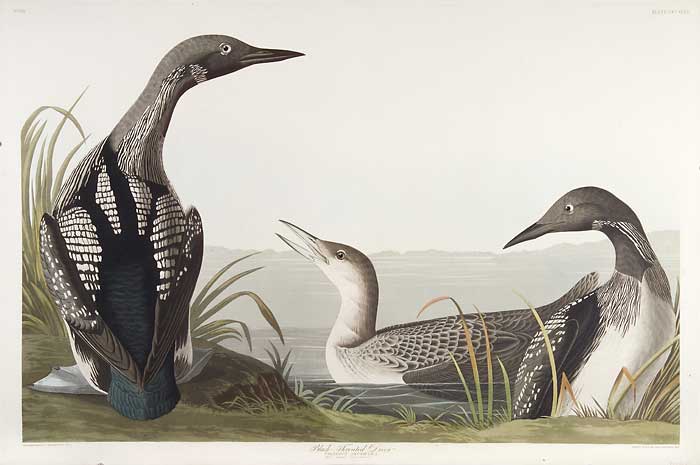
philadelphia print shop west birds of americaOn December 7th, a beautiful, complete copy of John James Audubon's Birds of America sold at Sotheby's auction in London for a hammer price of 6.5 million pounds. With the commission charged by Sotheby's, this brought the total paid by the buyer to slightly over $11.5 million dollars! The work, complete with its 435 hand-colored aquatints bound into four volumes, sold to London art dealer Michael Tollemache. You can read the BBC report on the sale and watch an interesting video on the BBC News web site.

This is the most ever paid for a printed book, a record established both because Audubon is "the" great name in American natural history illustration, but also because this is a superb example of an extremely scarce book. Audubon's masterpiece was very expensive even when produced, so few were published. Just over 100 complete sets are known to exist, almost all of which are held in public institutions. The last complete set to go at auction sold for $8.8 million dollars in 2000.

It is interesting to note that when one takes into account inflation since 2000, the new record of $11.5 million is not a significantly higher price than was paid for the set a decade ago. So, I guess one can conclude that the value of this work is not really increasing that much. However, I would note that the economies of 2000 and 2010 are very different, so for the volume to even maintain its value is pretty impressive.

A sale of this magnitude is interesting to reflect upon. What is going to happen to this set? Will it affect the prices of individual prints? What does this say about the print market?

As to what is going to happen to the set, the new owner calls his set "priceless" and says that he will just keep it and enjoy it for a while, though he did not rule out eventually selling it. Frankly, I do not buy this (though it could, of course, be true). $11,500,000 is a lot of money for any dealer (unless Bill Gates decides to become an art dealer) to invest in something he is simply going to enjoy. My guess is that Mr. Tollemache already intends to sell or has already sold the set.

So, did the new owner buy the set with the intent of putting it on the market to see how it goes? I will say that I find it hard to believe the set was bought on speculation. Given that this is a very widely publicized auction price, and given that this is the most ever paid for a printed book, how much upside is there on the price that a dealer could ask? Certainly, even a small percentage, say 5%, is a lot of money ($575,000), but $11.5 million is a lot of money to put up front to make only half a million.

Now Mr. Tollemache made the surprising assertion that the amount he paid was well less than the amount one could get if one broke up the set and sold the prints individually (something his emphatically denied intending doing). This sure sounds a bit like a sales pitch to a prospective client (gee, Tom, just think, if your gold mines go bust you can always break the set and make a tidy profit selling them individually...).

However, Mr. Tollemache's claim is just not true. If one calculates the per print price of this set, it comes to about $26,500 per plate. That seems pretty reasonable when a good number of the better birds are bringing well over $100,000 each. However, if anyone has looked through the full set of Audubon images (you can do this even with the octavo set to understand this point), you will realize that there are a lot of prints of smaller or not terribly attractive birds where the prints sell on today's market for only around $2,000 each. And there are even more of these prints---of quite attractive and biggish birds---which sell for between $4,000 and $20,000, still under the average price of this set.

So, if you take out all these prints, the ones selling for under $20,000, the average cost of the remaining birds is much, much higher than $26,500. I have not calculated the exact figure of the 435 prints at today's retail, but I can tell you it will not be equal to, much less greater than, $11.5 million.

So, this raises a few questions: why did Mr. Tollemache make this implausible claim, what are his plans for this set, and how will this affect the market for Audubon prints? My guess to the first two questions is that Mr. Tollemache actually bid on this set for an unknown client. This would make a lot of sense, for if he is using someone else's money, then a small percentage profit would be great. This would also explain his comment on the break-up value, trying to make his client feel good about the purchase. It is even possible that Mr. Tollemache did the bidding for the client at only a token commission, as the publicity of being the buyer of this set is "priceless."

This is, I want to emphasize, pure speculation. I know nothing about Mr. Tollemache other than what I have read since the sale. My comments are also not really at all pejorative, for it would not be at all surprising if a new owner of this work would want to remain anonymous. Also if Mr. Tollemache is fibbing, it is a harmless fib and one of a sort that is not uncommon in the art world. I may be wrong, but it sure makes a lot more sense to me that Mr. Tollemache bought this for someone than that he bought it for himself.

As to how this sale will affect the market for Audubon prints, I think probably not a lot. First, as noted this price is not really that much higher than the 2000 price, when adjusted for inflation, so I do not think anyone is going to think all of a sudden that Audubon prints are worth more than they were. The publicity will increase interest in Audubon prints, but such increased interest does not often turn into an increase in sales/values. For instance, after Ken Burns' Civil War series appeared, there was a lot of increased interest in prints of the Civil War, but very little increase in sales of them.

I am, however, encouraged by the sale. Any publicity about an any prints helps raise the general awareness of the items with which I work, and that is great. Also, it shows that there is a belief that prints can be things which have a significant value and that even in today's economy they are worth investing in.