Showing posts with label Print People. Show all posts

Friday, April 22, 2011

A Cabinet of Curiosities

In my last blog, I wrote about what I call “novelty prints.” These are prints that were not intended to present a straight-forward picture, but that are unusual in the way they were intended to be used or viewed. About a year ago I came across a web site for a fabulous collection of such prints, The Richard Balzer Collection.

Dick Balzar collects all sorts of novelty prints and this web site is what he calls his Wunderkabinett, that is, his cabinet of curiosities. As he says in the introduction to his site, “Nearly five hundred years ago European collectors arranged their pieces in cabinets of curiosities (Wunderkabinette) in an attempt to display their rare pieces. As collections grew, the more ambitious set aside rooms called Wunderkammern (Rooms of Wonder) for visitors to come and view their collections. These were the first museums. Today, the internet allows the possibility of visiting museums without leaving one’s home, and similarly, the possibility of constructing a virtual Wunderkabinett -- my cabinet of curiosities."

Dick calls the theme of his collection “visual entertainment” and his collection includes the types of novelty prints I have already discussed (perspective views and horizontoriums), as well as many others such as “magic lanterns, peepshows, shadows, transparencies, thaumatropes, phenakistascopes and a variety of other optical toys.” The site focuses on “the presentation and cataloguing of these wondrous devices and their representation in a variety of forms from scientific tomes to representations in the popular culture of the period.” I have spent many an hour browsing through the site and it really is a Wunderkabinette!

As I find this topic of great interest and as this is the best collection of these prints I know of, I asked Richard if he would consent to an interview, which he graciously agree to:

Can you describe the character of your collection?

I like the idea that a collection has a character as well as a theme. The theme of my collection is easier to describe; it is visual media and is almost exclusively pre-cinema (before 1895). The three biggest areas of concentration of the collection, and each encompasses a wide variety of materials from objects to ephemera, are magic lanterns, peepshows, and optical toys. As to the character, it’s a reflection of the collector, a bit chaotic and eclectic.


How did you get started with your collection and what inspired you to start?

I came to collecting rather accidently. I was living in Oxford, England on a research grant and one weekend I went to an auction, something I had never done before. I was drawn to a set of photographic magic lantern slides from the 1880s that depicted daily life in China. The slides came with a beautiful but rather beaten up mahogany lantern, which I knew nothing about. No one else at the auction seemed interested so for 50 pounds (about $80) I bought the slides and the lantern.

A month later a friend told me someone was giving a magic lantern show in Birmingham, about an hour and half drive from Oxford. I went to the show, not expecting much, and was overwhelmed by a magical menagerie of painted circus figures gliding across the screen. Mike Simkin, the showman, really started me on collecting. After the show he invited me back to his house, and once I saw the treasurers of his collection I was hooked.


How big is your collection?

The English have a lovely turn of a phrase which is, “I have a modest collection”, which doesn’t exactly do justice to its size.


When were the objects in your collection made?

The vast majority of my items come from the 18th and 19th centuries. I have a small number of pieces from the 20th century and a bit more from the 17th century, and even a couple of pieces from the 16th century.


In what countries were your objects produced?


Items in my collection come from a wide variety of countries. I have shadow puppets from China, India and Indonesia. I have several wonderful prints from Japan and some peepshow related material from Russia. The largest country, as a contributor to my collection, is America accounting for probably 60% of my collection, not because it is the place with the most material but because it is my home and there are fewer collectors here collecting what I collect. Europe has more material but it also has more collectors seeking the material. Over the years, having lived in England and traveled extensively in Europe I have been fortunate enough to find a lot of material, particularly in England and France, although I’ve also found things in Germany and the Netherlands. Once I was lucky enough to buy a collection of leather skinned shadow puppets from a street vendor in Beijing.


What are your favorite types of objects?

I hate this kind of question because it suggests that in any collection there should be favorite types of objects. It would be easier for me to tell you about twenty favorite objects than four. If you asked at this moment (and of course this could change tomorrow) some of my favorite types of objects, I would say: Anamorphoses, Thaumatropes, Peepshow Boxes and Magic Lantern Prints. Writing this down I recognize that I didn’t mention peepshow prints, something that I wrote about in my book, Peepshows A Visual History.

If you asked what the most distinctive part of my collection is I would have said prints. Both the magic lantern, and peepshows were important visual icons of the 18th and 19th century and new (old) images keep turning up, which is a wonderful thing for a collector.

You seem to be interested in prints about optical items as well as prints that are the optical items themselves. How important is this to you and are you also interested in books on the topics?

Actually I am not so interested in pictures of the items themselves, but I am very interested in images that contain the objects. This probably isn’t very clear so let me say there were a lot of political prints, especially at the end of the 18th and throughout the 19th century where the peepshow and the magic lantern were used by artists to poke fun at particular politicians, royals or the government. Some of my favorites show a peepshow and an unsuspecting person bent over looking at a view while his pocket is picked. The person depicted looking at the show represents “the people” and his pocket is being picked, depending on the image, by a politician or the state.

If I keep saying I am very interested in something it will soon become apparent that I am interested in a great many things. One of the real joys of collecting for thirty years is that as you learn more about a subject, you often find more things to collect. I think it was five years of collecting magic lanterns before I began collecting optical toys, a wonderful array of persistence of visions toys from the 19th century with delightful Greek derived endings of trope or scope (meaning viewer), to add a certain educational panache. So you have, for example, Thaumatropes, Phenakistoscopes, Zoetropes, and Praxinoscopes all offering a host of visual delights. It was another five years before I began collecting peepshows and several more years before I became interested in antiquarian books about the things I collect. I wish I were fluent in languages in addition to English because it would make owning books in many other languages a deeper pleasure.


What major institutions are there that have significant collections similar to yours?

Sadly there is no major institution in the US with an extensive collection of the material I am interested in. The Getty Museum in LA has some great pieces and the MOMI (Museum of the Moving Image) in Queens, NY has some material. There are a number of museums with large collections of these materials in Europe. The two most impressive are probably the collections at Cinematheque Francaise in Paris, and the Film Museum in Turin.

Are there other private collectors in your field?

There are many private collectors in my field and each one has a different emphasis. In the US the biggest collector of magic lantern materials is Jack Judson and his collection is exhibited in his museum in San Antonio,Texas. In Europe there are numerous significant collectors. Three with the most spectacular collections are Werner Neke in Mulheim, Germany, Francois Binetruy in Versailles, France and Lester Smith, in London.

Is there a collectors' group or society related to your collection?

Wherever there are collectors there is a collector’s group. I belong to two:
The Magic Lantern Society of the US and Canada, and the Magic Lantern Society of Great Britain. Both are terrific organizations. They publish materials and hold conventions and are always looking for new members.


I have written about vue d’optique or perspective prints in this blog. What can you tell us about them?

These prints were primarily meant to entertain and educate. Travel in the 18th and for a good part of the 19th century was quite limited and any person could buy images of the world’s great cities and view them at their leisure at home. One could also educate their children about the wonders of the world with such images. They were very popular and were certainly collected at the time. The vue d’optiques are still readily available.

How did the market for these change over time?

Although originally intended as parlour entertainment, these prints were soon taken by showmen and displayed in peepshows in public spaces for a viewing public who would pay “a penny for a peep”. Soon the vue d’optiques were joined by more elaborate prints made specifically for viewing in a peepshow and I am very interested in these. The innovation was to pierce the image either with pin-pricks or cut-outs and to lay down colored paper on the back, so that when light came from the back the image could appear to be the same scene at night, with a star filled sky, lights in windows, silhouetted figures in windows, or fireworks. All this allowed a simple print to be transformed into a day/ night view. The craftsmanship required to make these views was impressive and the views are quite spectacular.

Are there any more recent types of optical objects which are not very valuable now but which might be in the future?

I am sure the answer is yes, but I don’t which ones to suggest. First, I don’t collect 20th century optical objects nor 21st century objects. Secondly, like many collectors, I collect with my heart and have not given much thought to which things would appreciate in value. What I have learned, often from mistakes, is that if you are interested in objects becoming more valuable it is usually a good idea to buy things in really good condition. This has not been a rule I have always followed. I like the items too much and have rarely let condition be the deciding factor in whether or not to buy something.

The Richard Balzar Collection is a wonderful collection and the web site is wonderful. As Richard says "Take a look. Perhaps you will see things you have not previously seen, learn something new. If you have more information on an item you see, sharing it will be a gift to me. Enjoy your visit!"

Friday, March 25, 2011

Visions West, a reprise

Back in January I went to the opening of the exhibition Visions West: 19th Century Expedition Arts at the Arvada Center for the Arts and was so impressed that I had to write a enthusiastic review in this blog. Well, the exhibit is going to be closing in just over a week, so now is the time to visit if you haven't yet!

The exhibition uses prints from the Graham and Barbara Curtis Collection. Mrs. Curtis and her daughter Kay Hunsaker were at the opening and I had the pleasure of meeting them. I asked Kay if she would answer a few questions about her parents and their collection and she kindly agreed.

Tell me a bit more about the collection.

It was my father's passion but my mother was very supportive and in the beginning, she learned to matte so that she could help him frame. The theme of his collection was the artistic documentation of the exploration, discoveries, and development of the American West. The original title he used for the collection was "Manifest Destiny, Exploration and Creation of the Nation."

How and when did your father start collecting?

Dad, a Geologist and hard rock miner at heart, always had a love of the Rocky Mountains, the mineral belt, and the exploration of them. Early on, he read about the West, and as he got older he started collecting antique geology and exploration books.

He then got the idea to share his love of America by giving "educational and enlightening" Bi-Centennial gifts in the form of western exploration lithography. While looking for suitable prints, he realized the extent of the availability, and the real treasures to be had. He found smaller, lesser known pieces of interest but when he found the "Rocky Mountains" by Bierstadt, he realized that famous prints could be obtained and that started his quest.


Were there types of prints or artists which he particularly liked?

Chromolithography is his favorite type, for he liked the bright, clear colors, but hand-tinting will always have a special place in his heart. Audubon's prints were his particular favorites as he always mentions them first, then adds Catlin, Bodmer, Bierstadt, and Moran. In truth, he has always loved birds and became a real "birder" after he acquired these prints.


What are his favorite prints?

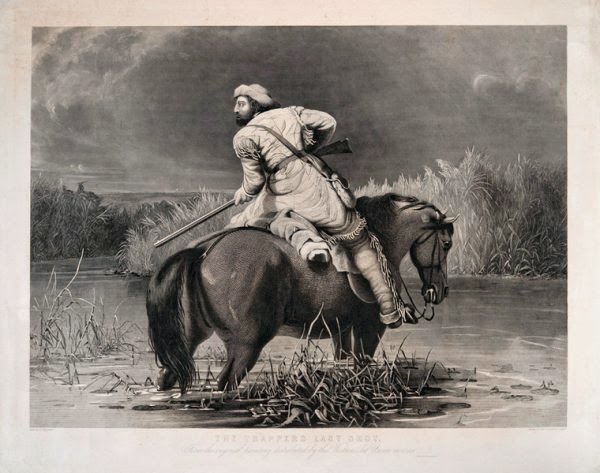
Audubon’s Virginia Partridge and the Male Wild Turkey, George Catlin’s Buffalo, William Ranney’s Trapper's last Shot, Thomas Moran's Grand Canyon, and Albert Bierstadt’s Rocky Mountains.


Was there any print he was looking for a long time and finally got?

The Currier print “The Last War Whoop.” He acquired it just this past August. He had first seen it at the Buckhorn Exchange in Denver, but didn't get it. He quit looking for the print in the last few years but I located it and helped him purchase it.

There is still one he wishes he had gotten and that is the Jolly Flatboat Men by George Caleb Bingham. I found one but it is just too expensive at $15K!

When was the collection first put on display and where else has it been shown?

It was first displayed by the Arvada Art Museum for six weeks in 1986. The museum was pretty new and their staff was small. Dad helped them paint the walls in preparation, Mom and Dad both helped them hang pictures, and assisted in the cost of advertising.

Parts of the collection were also displayed at the Golden, CO Heritage Museum about 1987 & 1988, in the lobby of a bank in Downtown Denver during Denver's Western Heritage awareness, in 1993 or 1996, and in the Littleton Museum twice, in 2006 and 2008.

I wish I had had the opportunity to meet Mr. Curtis, but seeing this super collection in this excellent exhibit did give me a sense of his love and knowledge of the material. Anyone interested in Western prints should make it a point to head over to Arvada to see the collection before it closes on April 3. More information can be found on the Arvada Center's web site.

Monday, December 13, 2010

Peter Marzio

I just learned of the passing, on December 9, of one of the superstars of the print world, Peter C. Marzio. Peter was the director of the Museum of Fine Arts in Houston, a post he held for almost three decades, and he was instrumental in helping build the museum into a world-class cultural center. He died last Thursday from cancer at age 67, much too soon.

Peter's was something of a rags to riches story. He was born into a working-class immigrant family, becoming the first in his family to graduate from High School. At Juniata College he became inspired by the art and museum world, deciding to make this his career. He went on to earn a doctorate in art and American history from the University of Chicago. He served as curator of prints and drawings at the Smithsonian and then as director and chief executive officer of the Corcoran Gallery of Art, before becoming the director in Houston.

Peter is best known to the general public for his art scholarship, educational programs and for his dynamic leadership of the Museum of Fine Arts, Houston. However, for those in the print world, Peter is "the man" when it came to chromolithography. As I have mentioned many times in this blog, I think chromolithographs of the nineteenth century are among the most interesting and over-looked American prints and it was Peter's work which turned me on to these wonderful prints.

In 1979, while director at the Corcoran, Peter Marzio wrote his superb book on American chromolithographs, The Democratic Art. Pictures for a 19th-Century America, , as well as curated an exhibition on the subject at the Amon Carter Museum of Western Art. This was the first time that a serious work on American 19th-century chromolithographs was published and that a major exhibit on the subject was put on.

The books is tremendous and when I first read it, it opened my eyes as to the fascination and importance of these hitherto overlooked prints. Peter wrote in his preface that "My deepest wish is that this book will help students to see the field of American lithography as worth of research." It certainly has done that, and while Peter contributed a huge amount else to the art world, if this was all he had done, his name would still be one revered among those with an interest in American prints. The world is a poorer place now than before his death, but much richer for his having been in it.

Monday, August 2, 2010

Enthusiasm and life

Yesterday evening, my "favorite uncle" Charles Rand Penney died. This was quite a shock, coming just seven months after the passing of my father, and a mere two months after the death of my mother, his sister Virginia Penney Lane. Uncle Charlie was quite a remarkable man and I wrote a post in this blog about him just about a year ago. I am incredibly sad, but I am also grateful that I had Charlie as my uncle and was able to get to know him and love him over the last 30 years. Interestingly, our relationship was built on our shared interest in antique prints.

Charlie was probably the most enthusiastic, curious, and dedicated collector I have ever met. I got into the business I am in because of my enthusiasm for original graphic depictions of history. I did not learn my enthusiasm from Charlie, but we certainly shared that and I am convinced it runs in the Penney blood. What I did learn from Charlie is what can be done if one takes ones enthusiasm and channels it with focus and dedication.

Charlie at one stage had 100 collections, and while he spent the last decade or so deaccessioning so that he could find appropriate, lasting homes for his collections, he never lost his love of what he was doing. Until his health slowed him down, Charlie used to do everything himself. He had files on everything and everyone he came in contact with, he collected books and archives related to his collections, and he even lived in the midst of his statues, furniture, paintings, prints, Mr. Peanut memorabilia, and wooden hotel hangers!

Some of his collections were not terribly impressive, but others were absolutely world class. Charlie was interested in almost anything he came across and he probably would have collected a little of everything if he could. Charlie always brought enthusiasm, interest, and a willingness to invest to all his collecting; sometimes he needed a bit of focus and discipline and that is where our relationship bloomed.

I like to think that our relationship vis-a-vis his collecting was something that benefited both me and him. Obviously I had known Charlie all my life and he was always an interesting figure. Rather exotic and unusual, but always fun to be with and talk to. When I studied in Oxford, Charlie came to visit and that was when as an adult I first really got to know him. I told him how I was getting interested in old maps and prints. Charlie encouraged me and told me how he had quite a number of old prints in his collections.

Then when I went into business, he approached me about helping him improve his collection of antique prints. At that stage he had a lot of prints, mostly showing scenes in western New York, from Rochester to Niagara Falls. Some were in good shape, some not so much; some were in their "original state," others with new color added. I talked to him about how he should really focus on one particular topic (he chose Niagara Falls) and how he should use a series of criteria for what he would accept in his collection (for instance, avoiding "new" colored prints where possible).

Together we spent over a decade expanding and refining his collection of Niagara Falls prints. We got rid of the prints that didn't meet his new criteria and looked for better examples. We used references to build a list of what prints were out there and tried to acquire the most important ones. Whenever I came across a Niagara print not in his collection, Charlie would always agree to add it--rather of a dream for a printseller!

Soon it became apparent that his collection was the best there was on Niagara Falls prints; better than that in the Erie County Library, the Erie County or Niagara Falls Historical Societies, or even the Library of Congress. I also called to his attention that while there were a number of good books on Niagara Falls images and prints, there was no really exhaustive work that tried to document the entire scope of printed views of the Falls. So, with his typical enthusiasm, Charlie gave me the go ahead to write a book and even plan an exhibition on the topic from prints in his collection. After many years collecting and research, Impressions of Niagara. The Charles Rand Penney Collection opened in the summer of 1993 at the Castellani Art Museum of Niagara University. This was certainly one of the highlights of my professional life and I know also of Charlie's collecting.

To be able to share our enthusiasm and dedication together and produce something as worthwhile as that exhibition and the accompanying catalogue was a great thing. It showed me what was possible and it bonded us together in a lasting relationship, which unfortunately yesterday I lost. I think I carry my enthusiasm and dedication for antique prints and maps with me every day and while some of that I was born with, without doubt it is the model of Uncle Charlie which gives me a constant reminder that this is the way one should approach one's life. Charlie did not waste his time in the world; every day he got the most out of life that he could. He, I and everyone who knew him was enriched by this remarkable life. Thanks Uncle Charlie.

Thursday, February 25, 2010

Boston Athenaeum


New England is the home of some of the best institutional print collections in the country. I have already written about the Connecticut Historical Society and the American Antiquarian Society, and today I will talk about another New England institution with a world-class antiquarian print collection, the Boston Athenaeum.

For almost three decades, Sally Pierce was the Athenaeum's Curator of Prints & Photographs. Sally is a superb print scholar, author (and wonderful person), who helped to turn the print collection at the Athenaeum into one of the best in the country. From 1991, Sally was assisted by Catharina Slautterback, who also co-authored a number of publications with Sally. When Sally recently retired, it was natural that Catharina would succeed her as Curator of Prints & Photographs. The Athenaeum was very lucky to be able to pass on the baton to such a capable, knowledgeable and experienced successor. Catharina has graciously agreed to be interviewed in this blog about the Athenaeum and its collection.

What is the history of the Athenaeum’s collection?

The Boston Athenaeum was founded in 1807 as a library, art repository, natural history museum, and laboratory. In the 1820s, the Athenaeum opened an art gallery, one of the first public venues for exhibiting art in New England. Although paintings and sculpture were the focus of both the Athenaeum’s art collection and its exhibitions, works of art on paper were routinely acquired and displayed. Most of the prints were acquired through donations and ran the gamut from European portraits, landscapes and city views to locally produced engravings and lithographs. Although several important early American artists, such as David Claypoole Johnston, Benjamin Nutting, and Seth Cheney, were nominally in charge of the “Engraving Room,” there was no clear collecting policy or curatorship in the modern sense of the word. The collection grew accordingly with the exquisite and the mundane coexisting in less than ideal housing environments. In the 1870s, the majority of the Athenaeum’s art collections were put on long term loan with the newly formed Museum of Fine Arts Boston and the Athenaeum focused on its mission as a library. Throughout the remainder of the nineteenth century and well into the twentieth century, works of art on paper were purchased primarily, although not exclusively, for documentary purposes, i.e. as art or geographical references.

The haphazard growth of the Athenaeum’s prints and photographs collection, so typical of the times, changed dramatically in the mid-twentieth century. In 1943 Charles E. Mason, Jr. and others founded the New England Historical Art Society to promote the study of the “history and customs of New England as portrayed in paintings, prints, engravings, sculpture, and other works of art.” The Society was one of a number of organizations and individuals that sought to challenge existing prejudices against American art and specifically American prints. In 1949 the Society was dissolved and its collection donated to the Boston Athenaeum, thus forming the nucleus of an independent prints and photographs department within the institution.

The Athenaeum’s collection was thus transformed from a large, but loose, assortment of prints and photographs to a tightly focused collection documenting New England culture, history, and printmaking. In its early years, the Department benefited from the guidance and generosity of Charles E. Mason, Jr., known affectionately as “Monk,” and one of the earliest and most enthusiastic collectors of American prints, particularly Boston lithography. Sally Pierce became Curator in 1981 and under her stewardship, the Prints & Photographs Department expanded to become one of the nation’s most significant collections of early American works of art on paper. I joined the Athenaeum in 1991 and assumed the curatorship of the Department following Ms. Pierce’s retirement in 2009.

What is the range of prints in the Athenaeum graphics collection?

Today, the Athenaeum’s Prints & Photographs Department is an active and vibrant member of the American print world. The collection is consulted by researchers around the world and individual items are exhibited and reproduced on a regular basis. The collection is comprised of works of art on paper documenting New England and American history from the eighteenth century to the present. Although classified as a historical documentation collection, many of the Department’s objects also have great artistic and aesthetic merits.

Its holdings include the graphic work of artists as diverse as Paul Revere, John Carwitham, Abel Bowen, Winslow Homer, Fitz Henry Lane, and William Morris Hunt. All manner of printmaking is documented within the collection, from aquatints and etching, to mezzotints, lithographs, and the four-screen processes of the early twentieth century. The subject matter of the collection is equally diverse with portraits, landscapes, genre scenes, urban and factory views, as well as significant holdings in Civil War-related imagery. In addition to prints, the Prints & Photographs Department actively collects photography, drawings, watercolors, posters and architectural drawings. A fuller description of the Department’s holdings can be found on the Athenaeum’s website.

What do you see as the greatest strength of the Athenaeum graphics collection?

The greatest strength of the Athenaeum’s Prints & Photographs Departments is undoubtedly its collection of nineteenth century Boston and New England lithographs. Boston was a center for the lithographic arts from the 1820s to the 1880s and home to such important firms as Pendleton’s, J. H. Buford’s, and Louis Prang. These firms produced a wide range of material: letterheads, sheet music covers, advertisements, political cartoons, playbills, and “art” chromolithographs. The Boston Athenaeum collects all of these materials and, in the process, documents not only the history of printmaking in America, and specifically in New England, but also the cultural, political, and social milieu of the nineteenth century.

What part of the graphics collection would you most like to strengthen?

I am always looking to strengthen the Athenaeum’s collection of eighteenth and early nineteenth century prints in order to supplement our understanding of American printmaking. And I am continually adding to the Athenaeum’s nineteenth century lithographic collection. I am particularly interested in the work of three Boston lithographers.

The short-lived firm of Tappan & Bradford (later L. H. Bradford & Company) produced some of the most beautiful examples of the lithographic arts with a fineness of draftsmanship and subtle tonal printing unparalleled at the time.

The chromolithographic work of Charles H. Crosby & Company is little known today; his output has been overshadowed by the more prolific and financially successful firm of Louis Prang. Crosby was an appalling bad businessman (he went in and out of bankruptcy several times) but he employed highly skilled artists and his firm produced some of the most ambitious and creative chromolithographic advertisements of the day. His work is fairly scarce and I would love to be able to document the full range of his work.

One of my favorite lithographic artists of the nineteenth century is the great portraitist, Leopold Grozelier. Although he died at the young age of thirty-five, he was incredibly prolific. The Athenaeum has over 80 portraits by Grozelier but I would like to continue to add to our holdings; it would be particularly interesting to acquire examples of prints that he executed in France before immigrating to the United States in 1851.

Is there any one print or type of print not in the collection that you would like to add?
Like most curators, my desiderata, or want, list is endless and I can think of several examples of prints and type of prints that I would like to add to the collection. For example, the Athenaeum has not traditionally collected color wood cut prints of the early twentieth century. There was a particularly vibrant community of wood cut artists in New England at this time and it would be wonderful to add some of their work to the Athenaeum’s collection.

In addition to adding new objects to the collection, curators must often “upgrade” their existing historical prints. This is not discussed very often but in fact many eighteenth and nineteenth century prints have had a long and hard life before they end up in a public repository. They have frequently been exposed to light, backed in wood, and stained by water or other liquids. Many have also suffered from the overzealous conservation treatment, often irreversible, that was typical of the mid-twentieth century. The Athenaeum is not unique in having some prints that are too fragile or worn to be handled or displayed. When an important print is in bad condition, I will seek to “upgrade” it by purchasing a better impression when and if it becomes available on the market.

What is the most important task as curator at the Athenaeum?

My first and foremost task as a curator is to make the Athenaeum’s collection of graphic art accessible to researchers. There are many steps involved in making a work of art accessible. Work must be acquired, accessioned, cataloged, properly housed, shared with researchers and classes, and, in an ideal world, published and exhibited. As the sole employee of the Athenaeum’s Prints & Photographs Department, I am responsible for all of these tasks, many of which are quite time consuming. These housekeeping chores may not be particularly glamorous, but an object that is un-cataloged or improperly housed is not accessible to anyone. As a curator, I am eager for the objects under my care to be used and enjoyed by the present generation as well as future generations. I like to think that for every print in my collection there is at least one researcher. To increase the likelihood that researchers will find their prints, catalog records for the Athenaeum’s graphic arts collection are available on our on-line catalog “Athena.”

What projects do you have underway or planned for the Athenaeum for the future?

I will be working on a series of exhibitions for the Athenaeum’s Norma Jean Calderwood Gallery. The exhibitions will take place over the course of the next decade and will feature highlights from the Prints & Photographs collections. One of the first exhibitions will be devoted to the development of the chromolithographic arts in Boston in the nineteenth century. There are also plans for exhibitions on the Department’s collection of architectural drawings and recent acquisitions of contemporary art.

What long-term goals do you have for the graphics collection at the Athenaeum?

In 2000, the Athenaeum received an endowment for the purchase of contemporary works of art on paper. Contemporary works are acquired for their documentation of New England in the 21st century and as a record of artistic activities in the region. In selecting contemporary works, I consider how they relate and speak to the historic prints in the collection. For example, I have been purchasing the work of a local artist who photographs the decaying structures of former New England factories. The Athenaeum also owns nineteenth century prints of many of these buildings and together these works record the evolving history of the area’s built environment. A contemporary print is contemporary for only a short period of time before becoming “historic.” By acquiring works by living artists today, I am able to build a historic collection for the future.

Who uses the graphics collection at the Athenaeum?

A wide variety of researchers make use of the Athenaeum’s graphics collections. Many of the researchers are academics with specialties in American studies and the visual arts. Architects and architectural historians also use the collection heavily as do textbook publishers and film documentarians.

What is the most common request you get related to the graphics collection at the Athenaeum?
There are two major categories of requests for images at the Athenaeum: 1) the built environment and 2) social history. New England has a long history of reusing and transforming its buildings and I assist many researchers in their attempts to visually document the past and present lives of various structures. Social historians have become increasingly adept at using the visual arts to understand the past. Although there are trends in academia, there has been a strong and continued interest in abolitionism, African-American history, and gender studies over the course of the past few decades.

What other print collections (institutional) with American prints do you think are particularly good?

There are so many excellent public repositories of American historical prints in the country. In my neighborhood alone, there are several superb collections: the Massachusetts Historical Society, the Boston Public Library, Historic New England, and the American Antiquarian Society. Many of these institutions have good on-line catalogs to their collections and they are all, without exception, overseen by wonderful, hard-working, and dedicated curators.

Tuesday, February 2, 2010

New curator of graphic arts at the American Antiquarian Society

In a number of previous blogs, I have written about the American Antiquarian Society and its graphics collection, interviewed curator Georgia Barnhill, and posted my experience at the CHAVIC conference held there last autumn. I know that it may seem like I am biased towards the AAS, but today’s blog is an interview with Lauren B. Hewes, the institution’s new Andrew W. Mellon Curator of Graphic Arts. At last year’s conference it was announced that Georgia would be taking on a new position as head of CHAVIC and that Lauren, previously Georgia’s assistant, would be taking over as curator of the graphics collection. The AAS is very lucky to have had such an able person right in house to take over and so I thought the good news warranted an interview with Lauren….

1. How did you end up getting involved with prints?

My first experience with prints was actually in high school where I took a print-making class for an art requirement and just loved it. We had a great big etching press, acid baths, fume hoods, etc -- it was a very complete shop, so I got to try pretty much every technique except lithography. I first set type in the historic print shop of Shelburne Museum in Vermont where I worked as a curator for several years and learned all about letterpress and the book arts from the craftspeople who worked there as interpreters and printers. In graduate school I was hunting around for a work study position and Rafael Fernandez, the Print curator at the Clark Art Institute had posted a job in his print room. I worked with him for two years and learned a lot about the connoisseurship of fine prints and how a print study room operates.

2. What is your favorite subject / type of print in the AAS collection?

This is a fairly impossible question – it is a bit like asking someone to pick their favorite child! One area of focus during my student years was nineteenth-century American history, so prints that were produced in that period hold a special interest for me, but I really do not have a favorite. I should admit that lately, due to our various re-housing and inventory projects, I find that I am especially drawn to the rich ephemera collections at the Society – those small, carefully printed tickets for medical lectures, calling cards for Boston ladies, and valentines to Civil War soldiers etc. etc. – these are not really considered prints, but the printing and design are often exquisitely done.

2b. What is your favorite print in the collection?

Whichever print I am working with at the time you ask me! I tend to be very enthusiastic about each object in the collection and the scholars and researchers who work in the library often bring interesting perspectives to the prints and drawings under my care.

3. What do you see as the greatest strength of the AAS graphics collection?

Access! Our cataloguing records are just outstanding and I credit this to the staff over the years who carefully recorded the lithograph collection and the engravings before 1820. We are currently about a quarter of the way through an NEH grant called “Prints in the Parlor” to item-level catalogue a good portion of our 19th-century engravings, as well. Additionally, we have wonderful finding aides for many sub-collections that are not included in our larger catalogue, including collections of the works of David Claypool Johnston or our European Political Print collection. You can see many of these finding aides on our Library Collections page.

4. What part of the graphics collection would you most like to strengthen?

The Society’s graphic arts holdings are very strong and broad. A description of the collection can be found on our website and reveals the real pillars of the print collection – the 18th century engravings and the 19th century lithographs and engravings. Since the collection is already so exceptional, I try to add strength by providing better access to collections that we already hold. Over the past few years we have really been trying to increase the availability of the Society’s photography holdings, for example.

5. Is there any one print or type of print not in the collection that you would like to add?

I always try first to fill in gaps of any pre-1820 separately published engravings that we may lack or any that are unrecorded in CAEP. This is an area identified as a priority in our collection policy. Also, I am always interested in anything related to the history of the book or American history – portraits of authors or specific events.

6. Now that you have become the curator, following Georgia Barnhill, what is the biggest task facing you?


Working with Gigi Barnhill is one of the best parts of my job! I was fortunate to be her assistant for several years and she has been a very gracious, kind, knowledgeable mentor. There are several large cataloguing projects ahead that Gigi and I have discussed over the years, one of which is the fantastic map collection that we hold. Currently this collection is available only via a card file. I am hoping to prepare a grant for the coming years that will permit us to catalogue the maps and make them accessible to readers.

7. Will you and Georgia Barnhill be working together?

Oh yes! Gigi is currently the Director for the Society’s Center for Historic American Visual Culture and the programs that she organizes in that capacity usually draw on the graphic arts collection.

8. What projects do you have underway or planned for the AAS for the future?

I have already mentioned two of these – the NEH-funded project that involves the separately published 19th-century engravings (which also has a component involving gift book illustrations) and the map project, which will organize and item-level catalogue our collection of maps. We are also processing our large holdings of ephemera and I will be rehousing and inventorying the Society’s collection of 19th-century valentines over the next year or so. We will continue to work to provide increased access to all aspects of the collection. There are plans underway to digitize our Paul Revere engravings in order to create a web-based inventory of these for teachers and scholars.

9. What long-term goals do you have for the graphic collection at the AAS?

To continue to provide high-quality access and control of the collection. One of the collections that I have under my care is the collection of sheet music – all 60,000 songs! Currently these are indexed in a card file available only in our reading room. Wouldn’t it be great to have a digital resource like the Lester Levy Collection at John Hopkins where you can search by composer or lithographer or key word? It will take a very long time to complete, but that is one of my goals for the collection!

10. What is your favorite print repository / institution besides AAS and why?

I spent time in a lot of print rooms during my work as a bibliographer for the Print Council of America, so I have several answers for this. One of my favorite places to look at prints is the New York Public Library – the staff is great and the collections are outstanding – plus they have a lot of material on New York that we lack. The Boston Public Library and the Library Company in Philadelphia are rich resources for print research, as well. The print room of the British Museum would be up near the top, too, just to include a non-American venue in the mix!

Tuesday, January 19, 2010

The Color Explosion

I just realized that I was terribly remiss in not writing about a terrific exhibit at the Huntington Library in California which has been going on since October. This exhibit, entitled The Color Explosion, consists of a selection of nineteenth-century, color lithographs from the collection of Jay T. Last. It runs through February 22, 2010 and is well, well worth visiting if you can.

Jay T. Last, founder of Fairchild Semiconductor Corp., became a collector and scholar on the history of American lithography. In 2005, he authored a terrific book, The Color Explosion. Nineteenth-Century American Lithography. This extensively illustrated book discusses the commercial and technological history of American color lithography and includes documentation on many of the most important firms around the country. Jay is one of the leading print collectors and scholars in the country and this book and the new exhibit are wonderful documentations of his collection and scholarship.

Jay's collection, with about 135,000 objects, is the largest private collection of color lithographs in the country and very generously it has been promised as a gift to the Huntington Library. The exhibit includes about 250 items from the collection, including advertisements, art prints, calendars, books, labels, sheet music, toys and games, and trade cards. Many of these prints are very rare and all are eye-poppingly beautiful. This exhibit (and the collection) will knock your socks off! More information can be found on this exhibit on the Huntington web site.

The Huntington Library, Art Collections, and Botanical Gardends is a collections-based research and educational institution for scholars and the general public. It is a gem located in San Marino, California. and even without the Last collection, its graphic arts holdings--with works on European and American printmaking, book illustration and desgin, photography, and cartography--make the Huntingdon one of the best print repositories in the country. More information can be found on their web site.

Tuesday, November 17, 2009

Cartographic Reference Books


The number of print reference books available to collectors and scholars has grown considerably in the last decade or so. The largest increase in number of references related to prints has occured in the field of cartography. When we first went into business in 1982, there were a few basic, mostly general cartographic references, but now there are hundreds and hundreds of such references, with more coming out each year (the photo above is just about 1/5th of our map reference library).

There are still quite a number of good general references, but the real growth has been on subject specific books. Maps of the world, different regions, from different periods or cartographers, and so forth have all been studied and references printed on these topics. While not every topic a collector might focus on has its own reference work (for instance, I collect maps of Oxfordshire and there is no work on this particular topic), but most collectors will find some good references that to some extent focus on their area of interest (there are, for instance, a number of good books on British county maps).

The granddaddy of cartographic references is the series of volumes currently under production by the History of Cartography Project. This multivolume reference (currently three volumes have been issued) is planned to cover the entire history of cartography in great detail. This has and will continue to provide the baseline from which all other cartgraphic references will start.

In the latest issue of The Portolan, the journal of the Washington Map Society, Bert Johnson wrote up the results of a survey the society made of its members asking about cartographic references: which volumes they thought were most useful or special in some way. It is well worth reading the article, as it does highlight some of the best references both currently in print and out of print. Washington Map Society member Joel Kovarsky maintains a listing of what he considers to be the best cartographic reference books, which can be seen on his website.

One of the books mentioned in both the Portolan article and by Joel is Barbara McCorkle's New England in Early Printed Maps 1513 to 1800 , an excellent tome detailing the maps of New England from this period, listing different states, giving sources and locations of copies, and including many illustrations. This is a prototype of what the best recent cartographic references are like.

It is not surprising that this work would be so good, as Barbara McCorkle has long provided a shining example of cartographic scholarship. For many years Barbara worked as a reference and map librarian at the University of Kansas, Purdue, and Yale, ending up as the Curator of the Map Collection at Yale between 1981 and 1993.

Barbara's excellent reference on maps of New England was issued after her retirement and she has kept busy since, working on a very long-term project of documenting the many maps issued in English and American geographies of the 18th century. There were a plethora of maps in such volumes and up to now one often found these maps separated from the books, without any way to find out where they came from. That problem has now been ameliorated, for Barbara's efforts have finally resulted in the publication of a Carto-Bibliography of the Maps in Eighteenth-Century British and American Geographies.

This bibliography is published by KU ScholarWorks (University of Kansas) and it is an 0n-line PDF file which can be viewed on-line at no charge. A work clearly of sustained dedication by Barbara, this cartobibliography contains descriptions of about 6,700 maps taken from 470 geographies! This is a tremendous addition to the cartographic reference universe, a universe that, luckily for us, is growing all the time.

Thursday, October 29, 2009

Monticello

Last weekend I had the great pleasure of visiting Monticello again. Charlottesville was lovely with fall foliage and Thomas Jefferson's house is a wonderful building, with many facets of interest and beautiful grounds. Not surprisingly, of course, I was particularly interested in the many prints and maps that hang in Monticello and which can be seen on the tour.

Before I get into my thoughts about items I saw last weekend, I want to talk a bit about the curitorial collection at Monticello, curated by Susan R. Stein. Susan has been Monticello's curator since 1986, and in 2005 was named Gilder Curator and the Thomas Jefferson Foundation’s vice president for museum programs. Susan is well known for the excellent "Worlds of Thomas Jefferson at Monticello" exhibition and book from 1993 and she has been very active in building the collections of Jefferson material, developing museum programs, and placing items from the collection in Monticello so that Jefferson's home is as close to how it was when he lived there. Susan is also a print enthusiast and scholar and a wonderful asset to Monticello and the print world.

The Monticello curitorial collection includes approximately 5,147 artifacts, books, and works of art connected to Jefferson and the Monticello community. About 75 percent of these collections are exhibited and the remainder are available for study. Jefferson originally owned 60 percent of the artifacts on display.

There are many drawings, silhouettes, and paintings hanging on the walls, but I was struck with how many prints and maps are on display in Monticello. To me this reflects something about the character of Thomas Jefferson. Jefferson was a man who appreciated art, but my feeling is that he never looked at art simply for its aesthetics, but rather always looked for "content" or "meaning." While many paintings and drawings have meaning beyond their aesthetics, it is specifically the content or meaning of most prints which is their raison d'etre. Prints and maps, especially during Jefferson's life-time, were created specifically to depict the physical appearance of a place or person of interest, to tell a story, make a point, educate the viewer, or provide other useful information. These are things that would appeal to Jefferson's inquiring mind and so it is of no surprise to me that Jefferson had so many maps and prints hanging in Monticello.

The tour of Monticello begins in the Entrance Hall, which is where visitors would wait before being greeted there by Jefferson. To help them pass the time, educate them, and provide topics for conversation, Jefferson hung many natural history and cultural artifacts there, as well historical prints and a number of wall maps. Over the fireplace is a nice example of Asher B. Durand's engraving of John Trumbull's "Declaration of Independence." (The other two famous prints after Trumbuill's paintings, of the Death of Montgomery and the Battle of Bunker's Hill, are hanging in the library). Jefferson was, naturally, proud of his seminal role in the event depicted, so this was a perfect print to have on display when visitors entered him home.

For safety, the maps in the entrance hall are facsimiles, not originals (all the prints on display are originals), because as wall maps they are attached to wooden rollers and hanging on the wall without any sort of protection from a frame and glazing. The maps shown are mostly eighteenth century maps of the different continents, but there are also two important American maps. One is the Aaron Arrowsmith "“A Map of the United States of North America" from 1802. This is an interesting map in that is shows the country the year before Jefferson added the huge western territories through the Louisiana Purchase. The other map is the famous “A Map of the most Inhabited Part of Virginia" by Joshua Fry and Thomas' father, Peter Jefferson.

In the South Square room are hanging two prints from the Boydell Shakespeare portfolio. These are the actual prints that were owned by Thomas Jefferson, but which had been sold in the 1827 sale of Jefferson's estate. Two nicely engraved portraits are also hanging here, one of Lafayette and the other a colored aquatint of Jefferson. That portrait (image near top of this blog) was engraved by Michel Sokolnicki after Thaddeus Kosciuszko, a hero of the Revolution who later in life became one of Jefferson's friends. The tour guide told us that this print is referred around Monticello as the "Bob Hope" portrait of Jefferson, for obvious reasons! A note from Jefferson's grand-son indicated that this print hung in this room. Also in this room is a lovely example of John Binn's 1819 engraving of the text of the Declaration of Independence (this print usually hangs in the entrance hall, which is where Jefferson hung it). The text of the Declaration is surrounded by portraits of John Hancock, George Washington, and Jefferson, as well as the seals of the thirteen colonies. One of the interesting things in this room is the manner in which a series of small silhouettes and engravings are hung, one above the other, with ribbons. This was a popular way of displaying small frames in the eighteenth and early nineteenth century and it is nice to see this 'in the flesh.'

The next rooms (the library, study and bedchamber) show a number of engravings on the walls, but it is floor to ceiling paintings and prints once one walks into the parlor. This art is hung, one above the other, from wires attached to the top moulding or brass rods. This was one not-uncommon way of displaying art in a gallery at the time, which allowed for hanging lots of frames without having to hammer nails all over the walls. Jefferson's inventory of Monticello lists 24 portraits and 17 paintings in the parlor and it makes an impressive display. Included are a number of engraved portraits, including those of David Rittenhouse, Thaddeus Kosciuzsko, and Louis XVI.

I am not going to remark on every print nor every room at Monticello, but I will finish with the dining room, as it is graced by two of my favorite prints, the pair of 1804 aquatints of Niagara Falls by John Vanderlyn. Jefferson was interested in the natural beauty of America and so it was natural to include prints of this great natural wonder. Also shown in this room is another fine view, this an 1808 aquatint by J.C. Stadler after William Roberts showing Natural Bridge in Virginia. Jefferson thought Natural Bridge was a natural wonder to rival Niagara and indeed he owned the site from 1774 until his death. William Roberts, the artist, had given Jefferson original paintings of Natural Bridge and Harper's Ferry, which hung in the dining room, but these have since been lost. Jefferson also owned an aquatint after Roberts, an example of which currently graces this room.

There are more prints that can be seen at Monticello than I've mentioned, and even more in the curitorial collections. One can get more information on the prints by visiting the Monticello web site. Not only do they have descriptions of a number of the engravings in the Th: Jefferson Encyclopedia, but one can also get a virtual tour of the house. Still, the best way to see these prints and maps is by visiting in person, a trip well worth making.