


 Next week a really interesting print exhibition will open at the Davis Museum at Wellesley College in Massachusetts. Entitled With A French Accent. French and American Lithography Before 1860, it will run from March 14th through June 3rd. On display in the Morelle Lasky Levine '56 Works on Paper Gallery, the exhibition is free and open to the public.
 The exhibition is a joint project between the Davis Museum and the American Antiquarian Society. I have written many times in this blog about the AAS, one of the greatest and oldest American institutions with major collections of prints. The Davis Museum brings its own impressive credentials to this partnership. It is one of the oldest academic fine arts museums in the country, founded in 1889. It has an excellent permanent collection of paintings, sculptures, decorative objects and works on paper, and regularly holds fine exhibitions on many topics, including this new one on prints.


 It is curated by Georgia Brady Barnhill ’66, Director of the Center for Historic American Visual Culture, and Lauren B. Hewes, Andrew W. Mellon Curator of Graphic Arts, both of the American Antiquarian Society. As they state, the exhibition, and an accompanying publication, “uncover several themes: the importance of French technology, the circulation and reproduction of French imagery, the stylistic contributions of French lithographic artists, and the reproduction of American genre paintings by French publishers for distribution in Europe and the United States." Note that the latter point shows that the influence, at least to some extent, flowed both ways across the Atlantic.
 The exhibit opens next week, and I believe the book will be out at about the same time, but of equal interest is the related March 31st symposium, "French and American Lithography: History and Practice," also a free, public event. This will be co-hosted by the Davis Museum and the Center for Historic American Culture at the AAS. The symposium will “explore transnational interconnection, particularly the impact on American lithography of artistic exchange between France and the United States through the 19th and 20th centuries and into contemporary practice."
 While most of the US is suffering under cold & snowy weather, things look pretty nice down in Miami. This weekend there is a great reason to visit besides the great weather, the 2011 Miami Map Fair. Run by and held in the Historical Museum of South Florida, this is the preeminent map event of the year. 50 exhibitors are showing their wares on Saturday and Sunday, including many of the top map dealers in the world.
 One of the people who offen attends the map fair will be David J. Morgan, who just over a year ago opened a new non-profit museum, the CARTE Museum. Located at 2347 Christian Street in Baton Rouge, this museum was developed to make available to the public Dave's amazing collection for both research and exhibition. "Carte" is, of course, the French word for map, but Dave uses it also as an acronym for Cartographic Acquisition, Research, Teaching and Exhibition museum.
 Dave's collection has been built over the past 40 years and its focus is on the Gulf Coast, though it is also strong in maps showing the political development of the United States. The collection includes complete atlases, books with cartographic content, and maps from atlases and separately issued. So far two exhibitions have been mounted, one of the discovery of the Mississippi River from 1513 to 1764, and the other on West Florida. Next week, the museum is opening a new exhibition "Mapping the Mississippi River and Its Tributaries," which covers the period from about 1750 to 1820. Dave is also planning a "jam-up Louisiana Statehood bicentennial exhibit" with an opening reception on April 30, 2012.
  From the beginning of the nineteenth century, with the Louisiana Purchase, through the rest of the century, Americans have been fascinated by the trans-Mississippi West. This fascination created a ready market for images of the American frontier, a market that was served by a plethora of artists and printmakers.
 I have always been interested in depictions of the American West by those who were early travelers there, an interest which has become particularly keen with my move to Denver. I have begun to delve past those prints which I have studied for years, by artists such as George Catlin, Karl Bodmer, Albert Bierstadt, and Thomas Moran, and learn more about the many other artists who traveled to the West on private and government explorations. Thus it was that I was especially pleased to hear of a new exhibition opening up just a few miles from our shop in Denver on the subject of images of the frontier West.
 The exhibit is entitled "Visions West: 19th Century Expedition Artists," and it is running from now until April 3rd at the Arvada Center for the Arts and Humanities. I was able to attend the opening a couple of weeks ago and I was surprised and absolutely delighted at what a tremendous exhibit it is.
 The theme of the exhibit is nineteenth century printed images of the American West done by on-the-spot artists. The prints in the exhibit are from the collection of Graham Curtis (about whose collection I will be writing a blog in the near future), which were generously loaned to the Arvada Center by Graham and Barbara Curtis with the help of their daughter Kay Hunsaker. The quality, variety and scope of the prints in the exhibit are amazing, making this an exhibition which anyone interested in the topic has to try to come and view.
 The big names--Catlin, Bodmer, Bierstadt, Audubon, Moran--are all there, but the real strength in the exhibit are all the less well known, but equally important artists who documented the West between 1822 and 1883. Some of these artists, such as Seth Eastman, Peter Rindisbacher, and A.E. Mathews, were not part of Government expeditions, but most of the artists whose prints are on display were part of various explorations sent out by the Federal government. These include images by artists such as James W. Abert, John Mix Stanley, Samuel Seymour, John J. Young, Arthur Schott and many more whose accurate, first-hand images provide us with a window on the American West while it was still a "wild frontier."
 The exhibition in Arvada is very nicely presented. The prints are arranged by artist, rather than date, and this allows one to look at some of these familiar prints from a new perspective, focusing on the artists, not so much the expeditions. The staff has written informative text on each artist and his work, and so the exhibit is a feast for the mind as well as the eye. All involved should be proud of this wonderful exhibit and again I encourage anyone who can to stop by to see the exhibit before it closes on April 3rd.
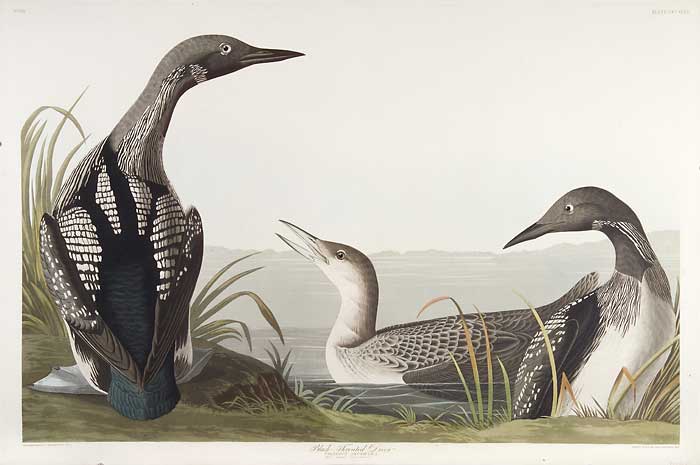
 On December 7th, a beautiful, complete copy of John James Audubon's Birds of America sold at Sotheby's auction in London for a hammer price of 6.5 million pounds. With the commission charged by Sotheby's, this brought the total paid by the buyer to slightly over $11.5 million dollars! The work, complete with its 435 hand-colored aquatints bound into four volumes, sold to London art dealer Michael Tollemache. You can read the BBC report on the sale and watch an interesting video on the BBC News web site.
 This is the most ever paid for a printed book, a record established both because Audubon is "the" great name in American natural history illustration, but also because this is a superb example of an extremely scarce book. Audubon's masterpiece was very expensive even when produced, so few were published. Just over 100 complete sets are known to exist, almost all of which are held in public institutions. The last complete set to go at auction sold for $8.8 million dollars in 2000.
 It is interesting to note that when one takes into account inflation since 2000, the new record of $11.5 million is not a significantly higher price than was paid for the set a decade ago. So, I guess one can conclude that the value of this work is not really increasing that much. However, I would note that the economies of 2000 and 2010 are very different, so for the volume to even maintain its value is pretty impressive.
 A sale of this magnitude is interesting to reflect upon. What is going to happen to this set? Will it affect the prices of individual prints? What does this say about the print market?
 As to what is going to happen to the set, the new owner calls his set "priceless" and says that he will just keep it and enjoy it for a while, though he did not rule out eventually selling it. Frankly, I do not buy this (though it could, of course, be true). $11,500,000 is a lot of money for any dealer (unless Bill Gates decides to become an art dealer) to invest in something he is simply going to enjoy. My guess is that Mr. Tollemache already intends to sell or has already sold the set.
 So, did the new owner buy the set with the intent of putting it on the market to see how it goes? I will say that I find it hard to believe the set was bought on speculation. Given that this is a very widely publicized auction price, and given that this is the most ever paid for a printed book, how much upside is there on the price that a dealer could ask? Certainly, even a small percentage, say 5%, is a lot of money ($575,000), but $11.5 million is a lot of money to put up front to make only half a million.
 Now Mr. Tollemache made the surprising assertion that the amount he paid was well less than the amount one could get if one broke up the set and sold the prints individually (something his emphatically denied intending doing). This sure sounds a bit like a sales pitch to a prospective client (gee, Tom, just think, if your gold mines go bust you can always break the set and make a tidy profit selling them individually...).
  However, Mr. Tollemache's claim is just not true. If one calculates the per print price of this set, it comes to about $26,500 per plate. That seems pretty reasonable when a good number of the better birds are bringing well over $100,000 each. However, if anyone has looked through the full set of Audubon images (you can do this even with the octavo set to understand this point), you will realize that there are a lot of prints of smaller or not terribly attractive birds where the prints sell on today's market for only around $2,000 each. And there are even more of these prints---of quite attractive and biggish birds---which sell for between $4,000 and $20,000, still under the average price of this set.
 So, if you take out all these prints, the ones selling for under $20,000, the average cost of the remaining birds is much, much higher than $26,500. I have not calculated the exact figure of the 435 prints at today's retail, but I can tell you it will not be equal to, much less greater than, $11.5 million.
 So, this raises a few questions: why did Mr. Tollemache make this implausible claim, what are his plans for this set, and how will this affect the market for Audubon prints? My guess to the first two questions is that Mr. Tollemache actually bid on this set for an unknown client. This would make a lot of sense, for if he is using someone else's money, then a small percentage profit would be great. This would also explain his comment on the break-up value, trying to make his client feel good about the purchase. It is even possible that Mr. Tollemache did the bidding for the client at only a token commission, as the publicity of being the buyer of this set is "priceless."
  This is, I want to emphasize, pure speculation. I know nothing about Mr. Tollemache other than what I have read since the sale. My comments are also not really at all pejorative, for it would not be at all surprising if a new owner of this work would want to remain anonymous. Also if Mr. Tollemache is fibbing, it is a harmless fib and one of a sort that is not uncommon in the art world. I may be wrong, but it sure makes a lot more sense to me that Mr. Tollemache bought this for someone than that he bought it for himself.
 As to how this sale will affect the market for Audubon prints, I think probably not a lot. First, as noted this price is not really that much higher than the 2000 price, when adjusted for inflation, so I do not think anyone is going to think all of a sudden that Audubon prints are worth more than they were. The publicity will increase interest in Audubon prints, but such increased interest does not often turn into an increase in sales/values. For instance, after Ken Burns' Civil War series appeared, there was a lot of increased interest in prints of the Civil War, but very little increase in sales of them.
 I am, however, encouraged by the sale. Any publicity about an any prints helps raise the general awareness of the items with which I work, and that is great. Also, it shows that there is a belief that prints can be things which have a significant value and that even in today's economy they are worth investing in.


 A lot of confusing names of programs, I know, but this conference is a great example of the exciting results of new programs and collaborations which have been appearing at the Library Company and elsewhere. VCP@LCP is a program which promotes the study of historical images as primary source material (note that the images in this blog are all from the image data base they have put up on the Philadelphia on Stone web site). If you have read this blog regularly you will realize is a thing I am very keen on. As Cathy Matson, director of PEAES said, historic images are not just supplements to textural history, but they are primary sources which can provide unique information and insights.
 The period between 1820 and 1860 was one of tremendous change in the American economy, with the country moving from a primarily agrarian/rural society to an industrial/urban one. In this period, lithography made its appearance and grew to be the dominant printmaking medium. Lithography was not only a product of the changing American economy but it also graphically reflected that metamorphosis. Even more, in a period when many were illiterate or did not speak or read English, pictures provided them with much of their understanding of their world. Thus, these historic images helped to both form and disseminate the culture of the period. Last week's conference examined these and more of the fascinating aspects of American lithography in this period.
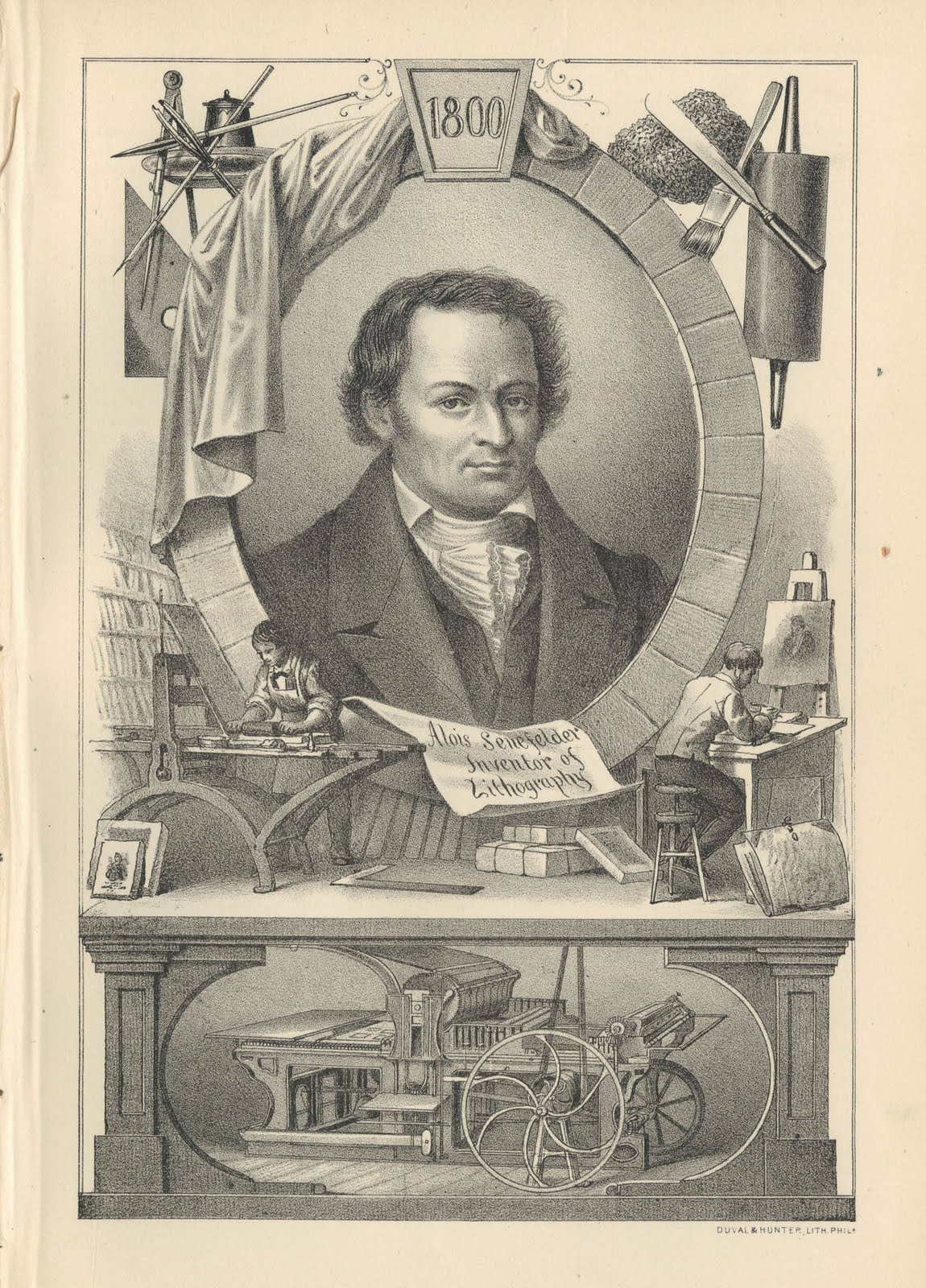 As an introduction, we were treated to viewing a film posted on YouTube which explains and demonstrates the process of lithography. It is worth viewing for anyone interested in how lithographs are made and can be seen here.
 All of the talks were stimulating. I learned a lot and ended the day with a load of questions I'd like to pursue, including:
 Without spending far more time than I can spend on this blog, I can only skim over some of the topics and questions generated by the conference. The conference was a great example of how current scholars are using historic prints to not only increase our knowledge of our past, but also to open up new avenues to explore.
 On May 20 to 22, the American Historical Collectors Society held their annual conference in Pittsburgh. The conference, run superbly by Marilyn Bruschi, was filled with good company, interesting talks, and visits to some of Pittsburgh excellent institutions.
 On Thursday we visited the Senator John Heinz History Center. The history center is the largest history museum in Pennsylvania and even includes the Western Pennsylvania Sports Museum. We had a couple of interesting presentations by the Anne Madarasz, the Museum Division Director, and David Grinnell, the chief archivist. The library, archives and museum include a large number of rare views and books on Pittsburgh history and I spent many, many hours there researching Panorama of Pittsburgh. It was fun to get to revisit the History Center and for other members of the AHPCS to see what a great resource and fun museum it is.
 At the end of the afternoon, we were the guests of Bruce Wolf at the famous Duquesne Club, founded in 1873, which has an impressive collection of paintings by local Pittsburgh artists, especially David Gilmour Blythe. The centerpiece in the visit was the viewing of the remarkable 1859 bird's eye view of Pittsburgh by James T. Palmatary. This is the only known example of this print and it was "discovered" and researched by Bruce, with help by AHPCS member John Reps.
 Friday was a very busy day filled with exhibitions and lectures. We started at the Carnegie Museum of Art, where we heard scholarly lectures on natural history illustrations in 19th century museum journals, by Bernadette Callery, and on sheet music covers by Mariana Whitmer, from the Society for American Music at the University of Pittsburgh. While I know a reasonable amount about both subjects, I found the lectures filled with interesting facts and insights. Following, I presented a lecture about one aspect of views of Pittsburgh I noticed while writing Panorama of Pittsburgh, viz. that an awful lot of these prints were simply copied from previously issued prints. This happens everywhere, but seemed particularly common in Pittsburgh.
 After lunch, we were treated to viewings of a number of wonderful exhibits at two of Pittsburgh's great institutions. We started at the Carnegie, where we viewed an interesting exhibit on "Sixteenth Century Tapestries and Related Prints," and an exhibit I particularly enjoyed on "Cariacature, Satires and Comedy of Manners," featuring prints by Hogarth, Daumier and Francisco Jose de Goya. Amanda Zehnder, who put together this thoughtful, fun and visually excellent exhibit, gave a personal tour, which was universally enjoyed. Following this we went to another Pittsburgh gem, the Hunt Botanical Library at Carnegie Mellon University, were we hear Lugene Bruno talk about botanical printmaking and were able to visit the library and its current exhibition. These exhibits are still up and I highly recommend them to anyone near Pittsburgh.
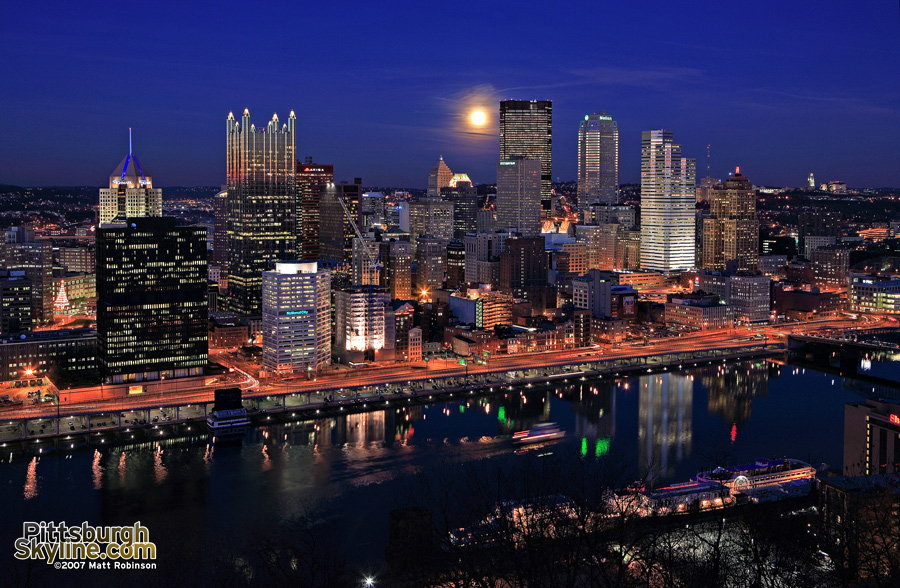 After this exhausting day, AHPCS members had the chance to explore some of Pittsburgh's superb restaurants and a number of us took the incline up to the top of Mt. Washington, where the view of Pittsburgh is unsurpassed. Unfortunately, I had to leave early the next morning before our visit to my favorite Pittsburgh institution, the Frick Art & Historical Center, the sponsoring institution for both the exhibit and book, Panorama of Pittsburgh. I was especially sorry to miss the presentation by George Nama, a friend who happens to be the most knowledgeable expert on Pittsburgh prints, as well as a terrific artist in his own right. I heard reports that his talk was wonderful, which would make it a fitting end to a wonderful annual conference!

