Showing posts with label Print references. Show all posts

Thursday, August 23, 2012

Re-Presenting the Past: Currier & Ives

In past blogs (for instance in the blog on print journals) I have written about the American Historical Print Society’s excellent magazine Imprint. This journal always contains articles of interest, but the recent Spring 2012 issue has an article of special note to me, Hazel Brandenburg’s "Re-Presenting the Past: Currier & Ives in 1920s America."


This well considered article looks at the role that Currier & Ives played in the American public’s consciousness in the 1920s. I have written several times over the years about how my particular fascination with antique prints concerns their role as cultural artifacts, both how and why they were made and how they were understood and used by the public. Dr. Hazel Brandenburg’s article takes this exact approach.


The decade of the 1920s was “a time of significant social disruption occasioned by the broad sweeps of urbanization, technological change, and the development of a new powerful mass culture.” (all quotes are from Brandenburg’s article in Imprint, Volume 37, No. 1) This general social unease led to a turning away by the American public from foreign influences and the “promotion of all things American.”


This social focus on Americana, though, was not on the unsettled and confusing modern America, but rather looked to America of years gone by. “Uncomfortable with the present and anxious about the future, Americans turned their eyes to the past—-or at least to a particular vision of an American past that seemed more authentic, uncomplicated, and pure.”


One of the reflections of this societal concentration on early America was an increase in interest in American antiques, where Americana collecting came to seen as “a patriotic endeavor.”
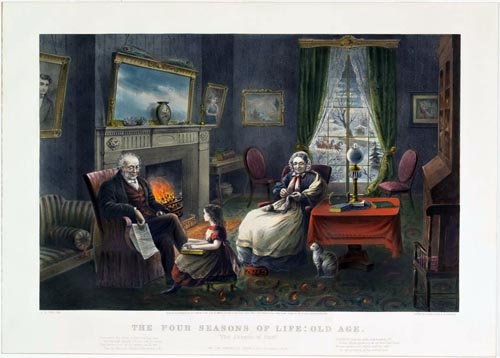

And what could be more an exemplar of American history that Currier & Ives prints, which “were the epitome of Americana; overwhelmingly American in subject matter, produced by American craftsmen, and displayed in American households, there was nothing else so distinctly American in the mind of many collectors.”


In the 1920s, there was a surge in interest in Currier & Ives prints, with these paradigm pieces of Americana increasingly being listed in shop inventories, advertisements and auctions, some of the latter of which almost exclusively consisted of this firm’s output.


The American public seemed to love these lithographs where “the scenes depicted in these prints provided direct visual ‘evidence’ of a simpler and happier American past.” And while the general trend at the time was a focus on the very early period in American history, the mid to late nineteenth century Currier & Ives prints still seemed to fit the bill for what the public wanted. “Although in actuality most of them were produced well after the ‘early American’ period being celebrated by collectors during this period, they seemed of a piece with the earlier furniture and accessories so eagerly sought after.”


This is all clearly and insightfully explained (in much more interesting detail) in the Imprint article, and this is just the type of thing I find fascinating. The article, though, resonated with me especially in the way it rings sympathetic notes with research I had done on an analysis of the differences between the Original and New Best 50 Currier & Ives lists which had been made-up, respectively in 1932-33 and 1991.


In the article I wrote based on that analysis (In Currier & Ives. The New Best 50. American Historical Print Collectors Society, 1991), I looked at the differences between the types of subjects that were popular with Currier & Ives aficionados from the 1930s and those from six decades later. I think many of the same feelings Brandenburg’s article discusses for collectors in the 1920s were still active in the ‘30s, and her work shines new light on what I had found previously.


One of the conclusions I came to was that general American “scenic” prints (scenes of charming houses in the woods or country and that type of thing) were the most popular type of prints in both periods. I think that the nostalgia of the 1920s for this idyllic, sylvan life-style is still present with Americans. Our forefathers never, of course, had such a simple and pleasant life, but this ideal image is clearly as strongly embedded in our national consciousness today as it was almost a century ago.


In contrast, perhaps the biggest difference between the lists from the different periods I noticed was the popularity of American historical prints with the Original lists compared to their singular lack of popularity in the New lists.


There were actually two lists for each period, one for large folio prints and one for small folio prints, but in both cases there was more popularity for historical prints in the Original prints versus the New prints. This was especially pronounced with the small folio lists. In the Original Best 50 small folio list there were 13 historical prints, over a quarter of the list. In the New Best 50 small folio list there was only one historical print, a mere 2% of the New 50.


When one looks at which historical prints were in the Original list, the vast majority were from the distant American past, not the more recent past, and even more interesting, their subjects were of events that took place before the Currier & Ives firm was producing prints, not those they issued on contemporary events.


For instance, there was only one war print in this list from those the firm issued contemporary to the events shown. There were none from the Mexican-American War and only one of the Civil War image “Terrific Combat Between the Monitor…and the Merrimac,” even though Currier & Ives issued many prints of both wars during the conflicts. Instead, most of the prints were from the American Revolution, e.g. “Washington Cross the Delaware,” “Cornwallis Is Taken!”, or even earlier, for instance, “Landing of the Pilgrims.”


Brandenburg’s article, I think, helps explain why these Revolutionary War and early American history prints were so popular early in the twentieth century. As she wrote, “Uncomfortable with the present and anxious about the future, Americans turned their eyes to the past—or at least to a particular vision of an American past that seemed more authentic, uncomplicated, and pure.” It was the early settlers and the founding fathers who expressed in clear terms what American was about, not the complicated issues and uncertainties of the Civil War, so it was these idealized prints which fit the American public’s mood at that time.


Today, in contrast, I think that while we still have an idealized vision in our heads of what life was like in the simpler past, we no more see the founding of this country as such a clear-cut noble and pure event. Instead, the approach to our history that most collectors have today is for authenticity rather than nostalgia.
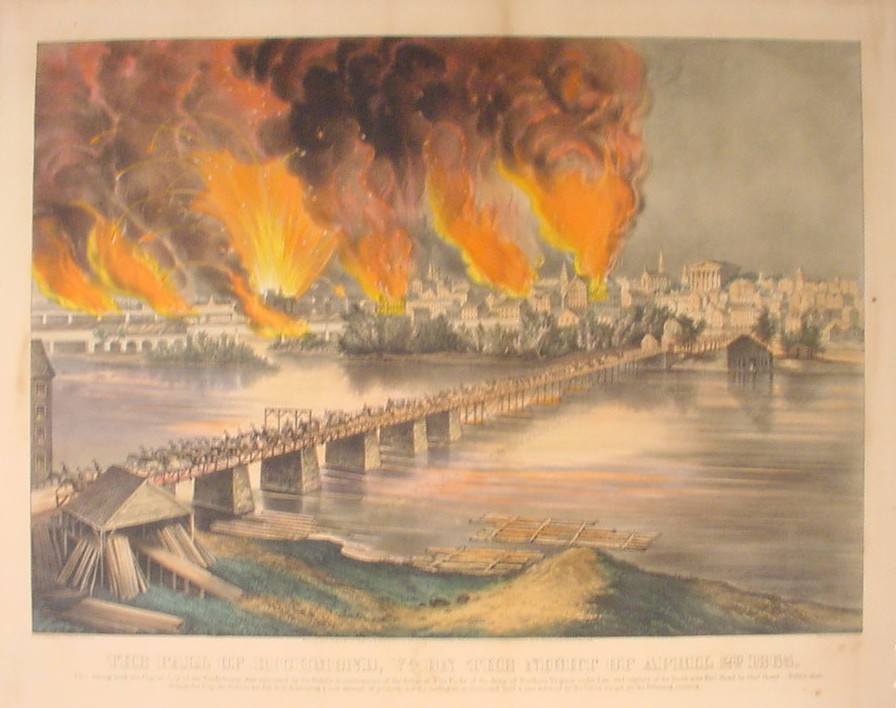

Today, collectors want, as much as possible, contemporary and accurate images of American history, not idealized images drawn by commercial artists a century after the fact. Even those prints by Currier & Ives which copy contemporary images have much less appeal as they add nothing to the original prints. It is interesting that the only historical print to make the New Best 50 small folio list was a contemporary print from the Civil War, “The Fall of Richmond, Virginia.”


There is much more to chew on by looking at tastes for Currier & Ives prints now, early in the last century, and of course at the time they were issued. Hazel Brandenburg’s "Re-Presenting the Past: Currier & Ives in 1920s America" is a really nice addition to the literature on this subject and well worth a read.


Tuesday, November 17, 2009

Cartographic Reference Books


The number of print reference books available to collectors and scholars has grown considerably in the last decade or so. The largest increase in number of references related to prints has occured in the field of cartography. When we first went into business in 1982, there were a few basic, mostly general cartographic references, but now there are hundreds and hundreds of such references, with more coming out each year (the photo above is just about 1/5th of our map reference library).

There are still quite a number of good general references, but the real growth has been on subject specific books. Maps of the world, different regions, from different periods or cartographers, and so forth have all been studied and references printed on these topics. While not every topic a collector might focus on has its own reference work (for instance, I collect maps of Oxfordshire and there is no work on this particular topic), but most collectors will find some good references that to some extent focus on their area of interest (there are, for instance, a number of good books on British county maps).

The granddaddy of cartographic references is the series of volumes currently under production by the History of Cartography Project. This multivolume reference (currently three volumes have been issued) is planned to cover the entire history of cartography in great detail. This has and will continue to provide the baseline from which all other cartgraphic references will start.

In the latest issue of The Portolan, the journal of the Washington Map Society, Bert Johnson wrote up the results of a survey the society made of its members asking about cartographic references: which volumes they thought were most useful or special in some way. It is well worth reading the article, as it does highlight some of the best references both currently in print and out of print. Washington Map Society member Joel Kovarsky maintains a listing of what he considers to be the best cartographic reference books, which can be seen on his website.

One of the books mentioned in both the Portolan article and by Joel is Barbara McCorkle's New England in Early Printed Maps 1513 to 1800 , an excellent tome detailing the maps of New England from this period, listing different states, giving sources and locations of copies, and including many illustrations. This is a prototype of what the best recent cartographic references are like.

It is not surprising that this work would be so good, as Barbara McCorkle has long provided a shining example of cartographic scholarship. For many years Barbara worked as a reference and map librarian at the University of Kansas, Purdue, and Yale, ending up as the Curator of the Map Collection at Yale between 1981 and 1993.

Barbara's excellent reference on maps of New England was issued after her retirement and she has kept busy since, working on a very long-term project of documenting the many maps issued in English and American geographies of the 18th century. There were a plethora of maps in such volumes and up to now one often found these maps separated from the books, without any way to find out where they came from. That problem has now been ameliorated, for Barbara's efforts have finally resulted in the publication of a Carto-Bibliography of the Maps in Eighteenth-Century British and American Geographies.

This bibliography is published by KU ScholarWorks (University of Kansas) and it is an 0n-line PDF file which can be viewed on-line at no charge. A work clearly of sustained dedication by Barbara, this cartobibliography contains descriptions of about 6,700 maps taken from 470 geographies! This is a tremendous addition to the cartographic reference universe, a universe that, luckily for us, is growing all the time.

Thursday, July 23, 2009

American Historical Print References

One of the most popular, and valuable, types of antique prints are American historical prints. These include images of battles, portraits of important figures, and historical allegories. From the eighteenth century and into the early twentieth, historical prints have been published related to almost every American historical event or person and this provides a fertile field for collectors or those simply interested in American history. Luckily there are a number of excellent references which cover these prints. There have been many published on particular individuals (e.g. Lincoln) or particular events (e.g. the Civil War), but there are also some fine references that are more general. Today I will discuss those I would recommend in particular to those interested in the subject. A couple of these works are out-of-print, but can be found on the internet or in good libraries.

Political prints form one of the largest types of historical prints and luckily there is a terrific book which documents this type of print based on the collections in the Library of Congress (which has the largest collection of such prints in the world). This is Bernard F. Reilly’s American Political Prints. 1766 – 1876. This wonderful book documents and illustrates the thousands of political prints in the LoC, each entry including an insightful analysis of the subject matter of the print. This is a good thing, as many of the political events/personalities depicted are now quite obscure and the symbolism not readily understandable to us today. The work begins with a Paul Revere engraving from 1766 related to the Stamp Act and ends over 600 pages later with a pro-Democratic campaign cartoon from 1878. This book is currently out of print.

Portraits of U.S. Presidents have been popular since Washington, with individual prints and series produced in engravings and lithographs of all sizes and quality. Noble E. Cuningham’s excellent Popular Images of the Presidency from Washington to Lincoln is the standard work on the topic. It documents and illustrates a wide range of Presidential prints, putting them into the context of their historic period and the history of print publishing.

E. McSherry Fowble’s Two Centuries of Prints in America 1680-1880 is an insightful documentation and analysis of prints from the Winterthur Museum Collection. It covers many more types of prints than simply historical ones, but there are many on this topic included and the descriptions of the prints made both in Europe and America explain the prints and put them into the wider context of American history and culture. This book is currently out of print.

These are an excellent place for someone interested in American historical prints to start. Beyond these, most of the print references are about specific topics and of these are there many terrific ones. This is a field of research that is booming and each year seems to produce a new crop of fine references. I'll be discussing new publications as they appear.

Monday, June 29, 2009

The Kelloggs of Hartford: their lithographs and a new reference book

I am thrilled to be able to say that an important new reference book has just been published, Picturing Victorian America. Prints by the Kellogg Brothers of Harford, Connecticut, 1830-1880. This book, edited by Nancy Finlay and published the Connecticut Historical Society, fills a large gap in reference material about nineteenth-century American lithography.

From about 1830 until the mid-1870s, four Kellogg brothers from Hartford, Connecticut, in various partnerships, published probably at least as many as 4,000 popular prints. While their output is considerably smaller than the approximately 8,000 prints issued by the firm of Nathaniel Currier/Currier & Ives, the Kelloggs were their chief competitors. The Kellogg’s prints were typical of the popular print style: colorful, affordable and with images covering much the same range of topics as those of their New York City counterpart. Subjects included portraits, historical events, scenes of daily life, views, religious themes, politics, sports, military, animals, sentimental images and any other topic that might be of interest to the American public. (More information on the firm can be found on our web site)

Nancy Finlay, the editor and author of one of the essays, has previously written a number of articles on the firm, and other references have appeared from time to time (including my article “The Kellogg Menagerie of Civil War Cartoons” from The Magazine Antiques, July 2006), but this excellent new book is the first comprehensive study of the Kellogg family and their copious output. Eight essays explore various aspects of the firm, their business, and nineteenth century lithography. The book is lavishly illustrated, with over 100 color illustrations and more than 1,000 b&w images. Besides the excellent essays, the book contains a wealth of other useful information, such a dating guide to the prints, biographies of the Kelloggs, a timeline of the firm, and an illustrated checklist of over 1,000 Kellogg prints. The book is available for $65 and it is a terrific value and an invaluable reference for anyone interested in nineteenth-century American lithography.

Nancy is the curator of graphics at the Connecticut Historical Society, which has a graphic collection of over 200,000 prints and photographs, including the largest collection of Kellogg prints in existence (over 1,100). Other important holdings in the CHS are prints by Amos Doolittle and Richard Brunton, drawings by John Warner Barber, and numerous 19th- and 20th-century views of Connecticut. Access to these collections are available through the research center (One Elizabeth Street in Hartford), where selections from the collections are also on view in permanent and changing exhibitions designed for adults and families. More information on the CHS and its collections are available on the society’s web site.

In anticipation of the publication of this wonderful volume, I asked Nancy to answer a few questions. I am most grateful to her for supplying the very interesting responses below…

How was the print collection formed?
The very first Kellogg prints to enter the CHS collection were donated by E.B. & E.C. Kellogg themselves in the 1840s. At that time, the Kellogg shop was right across the street from the Historical Society, which was located in the Wadsworth Atheneum. Although we’ve purchased a number of important Kellogg prints over the years, most of the collection has been the gift or bequest of collectors such as Samuel St. John Morgan in the 1940s and 1950s and more recently James Bonnette and Michael Shortell.

How can researchers access the collection?
The Research Center at The Connecticut Historical Society is open 12-5:00 Tuesday through Friday and 9-5:00 on Saturdays. Prints in the Graphics Collection may be viewed in the Research Center during those hours; no appointment is needed. However, I always enjoy meeting with print collectors and other researchers who are working with the Graphics Collection. If you want to be sure that I’ll be available to talk with you, or if you’d like me to have material ready for you in advance, you should give me a call at 860-236-5621 ext. 236 or send an email to Nancy_Finlay@chs.org.

Are your prints accessible on line?
Currently, a few of our Kellogg prints may be viewed on our website, www.chs.org and a few more are included in our digital library at www.cthistoryonline.org. Our complete Kellogg collection should be accessible online early this fall when our new online museum catalog goes live. Stay tuned.

How did you end up at the CHS?
I was born in Connecticut and had a summer job just down the street from CHS when I was in college. I used to visit CHS on my lunch hour. In the late 1990s, when I heard that CHS was looking for a graphics curator, I knew this was where I wanted to be. The Kellogg collection was no small factor in my decision to come here.

How did you become interested in antique prints?
My first love was European prints. I first became interested in 19th-century American prints when I was working in the Graphics Collection at Princeton University. Leonard Milberg was one of our big donors and Dale Roylance and I organized a major exhibition of his American landscape prints. I think it was Dale’s and Leonard’s enthusiasm for artists like William James Bennett and John Hill that first got me excited about their prints.

What are your favorite prints?
I have lots of favorite prints. I especially like the landscape prints that E.C. Kellogg produced in the early 1850s when he was working on his own. An example is "Plainville, Conn., from the South West," which is on the cover of Picturing Victorian America. It presents such an idyllic view of a small Connecticut town in the 19th century. It’s also a really fine example of color lithography. It makes you wish that the Kelloggs had done more with color printing. They really didn’t do very much.

What print was the biggest surprise when you came across it?
Probably "Blind Man’s Buff," an early D.W. Kellogg print. It’s based on a painting by the rococo artist Jean-Honore Fragonard. The Kelloggs used lots of European sources, including works by contemporary artists and old masters, but it surprised me that they would reproduce a Fragonard. It’s just a little risqué, but perhaps they didn’t see it that way.

Some of your prints must have been acquired in poor condition. Do you have a program in place to conserve those that need it?
I’m so glad you asked! We have an ongoing conservation program and have just received a major grant from the Institute of Museum and Library Services for the treatment of our Kellogg collection at the Williamstown Art Conservation Center. It’s a two-year project and will begin in September 2009.

What do you see in the future for the CHS print collection?
I’m focusing right now on building a strong 20th-century print collection for CHS. We’re also collecting some 21st prints. CHS collected contemporary prints during the 19th century, when they acquired prints directly from the Kelloggs, for example. Then they got distracted by the Colonial Revival and didn’t acquire much contemporary material for quite a long time. It’s important to document the present before it becomes the past, to make sure that strong collections exist to serve the needs of future researchers.

How do you think the Kellogg prints compare to those by the more famous firm of Currier & Ives?
Unlike Currier & Ives, the Kelloggs didn’t do a lot of large folio prints. They specialized in small-format prints and marketed them largely to the lower middle class. If you compare Kellogg prints to similar small-format Currier & Ives prints, they hold up very well. Many of their prints, such as their Civil War cartoons, are extremely clever and original, and many of them are technically very accomplished, especially some of their prints from the mid-1840s.

What does a study of the prints of the Kellogg firm teach us?
It teaches us a lot of different things. They demonstrate very clearly that not everything in the 19th century was happening in major urban centers like New York and Boston. The Kelloggs were very much in the forefront in the development of the popular print in America. You can actually trace the evolution of the typical “Currier & Ives” print by examining the Kelloggs’ early work. The same thing was happening in other places, too, at about the same time. Everyone pretty much knew what everyone else was doing.

How many total prints do you think were issued by the Kellogg firm?
A lot more than we suspected at first. We now know of almost 2000 different prints that were issued between 1830 and 1880. There probably were at least 4000 prints, perhaps 5000. The Kelloggs also did a LOT of book illustrations, and we’re just beginning to learn about those.

Now that the Kellogg book is out, what is the next project you are working on?
I’ll never entirely stop working on the Kelloggs. I’d like to produce a complete catalogue raisonne of their work and put it online. And I’d like to find out more about their relationships with Hartford printers and publishers. Michael Shortell, who did so much work on our Kellogg project, is compiling a database of Hartford printers and publishers. He discovered account books from the firm of Belknap & Hamersley that include references to the Kelloggs. They tell you how big the editions were, how much they were paid, exactly what they did. I am working on some other projects, too, involving late 19th- and early 20th-century book design and Hartford architecture. I’d like to do something with Nelson Augustus Moore and his family, too. Moore was a photographer as well as a painter, and almost all of his children were also artists. I never run out of ideas.

Friday, May 29, 2009

Ewell L. Newman Award

At the recently held American Historical Print Collectors Society (AHPCS) annual meeting in Portland, the 2009 winner of the Ewell L. Newman Award was announced and I am really pleased that the award went to Panorama of Pittsburgh, the book on 19th century printed views of the city which I authored.

The Ewell L. Newman Award has been awarded yearly since 1989 by the AHPCS in order to recognize and encourage outstanding publications enhancing appreciation of American prints before 1900. As described by the AHPCS:
Small and large works, those of narrow scope and those with broad general coverage are equally considered. Original research, fresh assessments, and the fluent synthesis of known material will all be taken into account. The emphasis is on quality and on making an outstanding contribution to the subject. Exhibition catalogues, monographs, articles, and works based on local sources are eligible.

Panorama of Pittsburgh served as the exhibition catalogue for an exhibit held at the Frick Art & Historical Center in Pittsburgh from June to October, 2008. This was the most comprehensive exhibit of printed views of Pittsburgh ever produced and it was selected as one of the best 2008 exhibitions in Pittsburgh by both major city newspapers.

The catalogue, Panorama of Pittsburgh contains color images of all the items in the exhibit, and the thematic essay begins with images of Pittsburgh before the fire of 1845 and progresses through views from books and magazines, prints documenting events, illustrated newspapers, frameable views, advertising, music sheets, and other types of prints.

This book, however, was intended not just as an exhibition catalogue, but also as a long-term reference on nineteenth-century views of Pittsburgh and Pittsburgh printmakers. Thus is provides background information on the most prominent Pittsburgh-based printmakers, a list of Pittsburgh printmakers assembled from period sources and the most encyclopedic list of nineteenth-century prints of the city that has ever been assembled. The Frick produced a beautiful catalogue, the form wonderfully complementing the content. I was very pleased with how it came out and I am also, obviously, delighted that it won the Newman Award.

The past winners of the award make an impressive list, including significant books on many different topics. Among the references on historical prints are Sherry Fowble's Two Centuries of Prints in America, Gloria G. Deak's Picturing America, Bernard Reilly's American Political Prints, 1766-1876, Noble E. Cunningham's Popular Images of the Presidency , and Mark Neely and Harold Holzer's The Union Image: Popular Prints of the Civil War North.

References on American views are equally well represented, including Ron Tyler's Prints of the West , Sue Rainey's Creating Picturesque America, and John Rep's St. Louis Illustrated and John Casper Wild . These are only some of the excellent books which have won the award, providing very good company for Panorama of Pittsburgh.

Call for entries: The AHPCS is always looking for submissions for the Newman award. Publications remain eligible for a period of roughly two years after they first appear. Once a work has been passed on by the Jury it will not be considered again except in a substantially revised edition. Jurors include collectors, authors, and scholars, of American historical prints. To submit a book to the Jury for consideration, please mail to the Jury chairperson at: Cottonwood Press Books, Attn. William Huntington, P.O. Box 24337, Omaha, NE 68124.

N.B. In this blog I use this symbol [] to indicate that the Philadelphia Print Shop sells a particular reference work mentioned. Just click on the symbol to go to our listing of that book.

Friday, April 3, 2009

Basic print reference books

Reference books and articles are an important resource for anyone interested in antique prints. In recent years there has been an significant number of new books coming out on all sorts of print-related topics and there is also, of course, a library of classic references which are still relevant. The journal Imprint contains new articles twice a year and more articles appear in other periodicals on a fairly regular basis. Luckily, in 2006 there appeared an excellent Bibliography on American Prints of the Seventeenth through the Nineteenth Centuries , compiled and edited by Georgia Barnhill. Divided into subject categories, this work lists virtually every text on American prints from the period noted that had been published up to 2006, providing an excellent means of finding references on topics of interest.

In a regular series of blogs, I plan to post annotated lists of print references on different topics. As with this blog, the lists I will compile will be focused similarly to Barnhill’s bibliography, that is, on references related to American prints from the seventeenth through nineteenth centuries. These lists are not intended to be comprehensive, but rather to call attention to the most useful print references that are relatively easy for someone to either purchase or find in a library. Most of the references are on specific topics, such as Civil War images, prints by various printmakers, or views of particular locations, but I will start by considering general print references.

  • Frank Weitenkampf. American Graphic Art. 1912. Out of print. The classic history of American graphic art from colonial times to the beginning of the twentieth century. Though somewhat dated, this is the place to start when considering most aspects of American prints. It belongs in every collector’s library, though this volume is now available on-line.

  • Carl W. Drepperd. Early American Prints. 1930. Out of print. This is a nice introductory book intended for print collectors. It covers American prints from the colonial period up through Currier & Ives and contains chapters with useful information for a collector, including how prints are made and lists of different printmakers and their works.

  • A. Hyatt Mayor. Popular Prints of the Americas. 1973. Out of print. A large, well illustrated book with brief essays on different subjects. Not that well organized nor comprehensive, but with lots of interesting information and a wide selection of topics, including printmaking in Spanish America. A nice book as an introduction to the subject, but not for a serious researcher.


  • John & Katherine Ebert. Old American Prints for Collectors. 1974. Out of print. Another general book intended for the collector, this work has its flaws, but it also contains much of interest. Designed for a beginner collector, it does show a wide variety of different types of prints and has some useful information included, such as a glossary of print terms.


  • E. McSherry Fowble. Two Centuries of Prints in America, 1680-1880. 1987. Out of print. One of my personal favorite print references. Though limited to a selection of prints from the Winterthur Museum collection, the extent and quality of that collection and the variety of prints selected by Fowble means that this book still provides an excellent over view of prints in the period noted. Fowble includes two insightful introductory essays and each print is beautifully illustrated and well described. Along with Weitenkampf, I would recommend this as an essential book for anyone interested in the topic.

  • Christopher W. Lane with Donald H. Cresswell and Carolyn Cades. A Guide to Collecting Antique Historical Prints. 1995. Designed as an inexpensive, basic guide on the subject. Though fairly short, this guide covers most subjects that a collector should know about. Most of the content of this guide likely will eventually find its way into this blog...


  • Leila Lyons. Collecting Prints. 2006. An “Instant Expert” guide, similar in intent and content to Lane’s. Contains useful lists of museums and collections, places to purchase prints, and a glossary of print terms.

    All but the last two of these books are out of print, but they can still often be found for sale from print dealers or in used books shops around the country. Here, and in future blogs, I will use this symbol [] to indicate that the Philadelphia Print Shop sells a particular reference work mentioned. Just click on the symbol to go to our listing of that book. Also, these are fairly basic works, so many good libraries will have a copy of these books.
  • Friday, March 27, 2009

    Print Journals

    There are quite a number of excellent academic journals on maps, but few journals at all that primarily cover antique prints. Here is a list of those currently being published.

    • Imprint
      Imprint is a biannual journal issued by the American Historical Print Collectors Society. To say simply that it is the best journal for those interested in American historical prints does not really convey how good it is. The production quality of Imprint is first rate, with full color, and the articles are always of interest, ranging from shorter notices on print topics, collections and institutions to longer articles that are well-researched and scholarly. Also included are book reviews of newly published print references. A subscription to Imprint is reason enough to join the AHPCS. An index of back issues (which are available from the AHPCS) can be found on the AHPCS web site.

    • Print Quarterly.
      The Print Quarterly is an academic journal issued quarterly in England. Well illustrated (though in black & white only), each issue contains a number of scholarly articles, followed by a few "Shorter Notices," notes, and catalogue and book reviews. The focus of the journal is mostly on fine art prints, with relatively little attention paid to American prints. Subscriptions are available in the United States and more information can be found on the Print Quarterly web site.

    • Journal of the Print World
      The Journal of the Print World is a tabloid, newspaper-style periodical issued quarterly out of New Hampshire. For over three decades the Journal has provided wide coverage of prints, with articles on exhibitions, auctions, artists, and reference books. There is information on European topics, but the focus tends to be on American prints. Both fine art and historical prints, modern and antique, are well covered. Most American print dealers, print fairs, auctions, and exhibitions are advertised in the Journal, so it is an excellent way to keep up on the world of prints, as can be seen on the Journal's web site.