Showing posts with label Prints on the web. Show all posts

Monday, March 19, 2018

John Reps on American Bird's Eye Views

I just wrote about the excellent exhibit on Fowler's bird's-eye-views of Pennsylvania towns which is at the State Museum of Pennsylvania (as well as on line). One thing which I didn't mention was the excellent slide-show presentation on the general subject of American bird's-eye-views put together for the exhibit by John Reps.


John Reps is the dean of scholars on this topic. His classic Views and Viewmakers of Urban America is the "bible" on the subject, not only because of Reps amazing listing of thousands of these views, but also because of his insightful text on the views and their makers. Well, John added to this story in a very interesting slide show which can be seen on the internet. It talks about how the prints were made and includes some fascinating images that I have never seen. Anyone interested in this topic should take a look!


Wednesday, February 22, 2012

Men in the Young Republic

I have been a bit remiss in keeping this blog up-to-date with announcements of good print exhibitions, both in the physical and virtual worlds. Luckily, there is a fine, new online exhibit which I can call to your attention.


This is the American Antiquarian Society's exhibit, Men in the Young Republic. The AAS has a number of excellent exhibits on their web site, including the terrific Beauty, Virtue and Vice: Images of Women in Nineteenth-Century American Prints and this new exhibit maintains the high quality of the others.


The theme of the exhibit is a look at the depiction of American men and their world in popular prints from the first half century of the United States. There are sections on their home life, occupations, associations, fashions and recreations. The exhibit was curated by Sally Pierce, curator of prints and photographs at the Boston Athenaeum and editor of the American Historical Print Collectors Society's journal, Imprint.

Sally was recently interviewed for the AHPCS's News Letter about some of issues involved with online exhibitions. Excerpts from this interview follows (note that if you join the AHPCS, you would get both the newsletter and journal with your membership...):


News Letter (NL): How did you translate your selections [of prints for the exhibition] for a web audience--was it different?
Sally Pierce (SP): The process was a little different in preparing for the web....With physical space all elements come into play--size, harmony, orientation, color and style, while in the online space, you have different considerations. One they they have in common is attention to the condition of the items; there were some items I wanted to include, but the condition was so poor that it would not make for a good representation. This is especially true online as you want viewers to be attracted to the images enough to come and see them in person.


NL: Physical exhibits are noted for their abiity to inspire--did you keep this in mind for views?
SP: One exciting thing about online exhibitions is that, as a curator, you are freed from physical constraints of size--everything is equalized on the screen. So a large print and a book illustration can be displayed at the same dimensions. I believe this has an impact.


NL: As you have worked in galleries and museums, what challenges do you feel there are when moving exhibitions online?
SP: Well, for one you are looking at a surrogate of the item--which is great for getting your point across--but what you lose when not looking at a physical object is the connoisseurship of knowing different mediums, feels, tones etc. If one wants to be an art historian or a collector, the online environment does not move you forward enough to develop essential skills; or if you are an historian, it doesn't necessarily help you to envision the actual object. I'm not arguing that the web doesn't equal information, but to gain a deeper understanding, you need the object. On the flip side, the web presents the opportunity to bring people in to see your collection and online exhibitions can be great advertising.

Friday, April 22, 2011

A Cabinet of Curiosities

In my last blog, I wrote about what I call “novelty prints.” These are prints that were not intended to present a straight-forward picture, but that are unusual in the way they were intended to be used or viewed. About a year ago I came across a web site for a fabulous collection of such prints, The Richard Balzer Collection.

Dick Balzar collects all sorts of novelty prints and this web site is what he calls his Wunderkabinett, that is, his cabinet of curiosities. As he says in the introduction to his site, “Nearly five hundred years ago European collectors arranged their pieces in cabinets of curiosities (Wunderkabinette) in an attempt to display their rare pieces. As collections grew, the more ambitious set aside rooms called Wunderkammern (Rooms of Wonder) for visitors to come and view their collections. These were the first museums. Today, the internet allows the possibility of visiting museums without leaving one’s home, and similarly, the possibility of constructing a virtual Wunderkabinett -- my cabinet of curiosities."

Dick calls the theme of his collection “visual entertainment” and his collection includes the types of novelty prints I have already discussed (perspective views and horizontoriums), as well as many others such as “magic lanterns, peepshows, shadows, transparencies, thaumatropes, phenakistascopes and a variety of other optical toys.” The site focuses on “the presentation and cataloguing of these wondrous devices and their representation in a variety of forms from scientific tomes to representations in the popular culture of the period.” I have spent many an hour browsing through the site and it really is a Wunderkabinette!

As I find this topic of great interest and as this is the best collection of these prints I know of, I asked Richard if he would consent to an interview, which he graciously agree to:

Can you describe the character of your collection?

I like the idea that a collection has a character as well as a theme. The theme of my collection is easier to describe; it is visual media and is almost exclusively pre-cinema (before 1895). The three biggest areas of concentration of the collection, and each encompasses a wide variety of materials from objects to ephemera, are magic lanterns, peepshows, and optical toys. As to the character, it’s a reflection of the collector, a bit chaotic and eclectic.


How did you get started with your collection and what inspired you to start?

I came to collecting rather accidently. I was living in Oxford, England on a research grant and one weekend I went to an auction, something I had never done before. I was drawn to a set of photographic magic lantern slides from the 1880s that depicted daily life in China. The slides came with a beautiful but rather beaten up mahogany lantern, which I knew nothing about. No one else at the auction seemed interested so for 50 pounds (about $80) I bought the slides and the lantern.

A month later a friend told me someone was giving a magic lantern show in Birmingham, about an hour and half drive from Oxford. I went to the show, not expecting much, and was overwhelmed by a magical menagerie of painted circus figures gliding across the screen. Mike Simkin, the showman, really started me on collecting. After the show he invited me back to his house, and once I saw the treasurers of his collection I was hooked.


How big is your collection?

The English have a lovely turn of a phrase which is, “I have a modest collection”, which doesn’t exactly do justice to its size.


When were the objects in your collection made?

The vast majority of my items come from the 18th and 19th centuries. I have a small number of pieces from the 20th century and a bit more from the 17th century, and even a couple of pieces from the 16th century.


In what countries were your objects produced?


Items in my collection come from a wide variety of countries. I have shadow puppets from China, India and Indonesia. I have several wonderful prints from Japan and some peepshow related material from Russia. The largest country, as a contributor to my collection, is America accounting for probably 60% of my collection, not because it is the place with the most material but because it is my home and there are fewer collectors here collecting what I collect. Europe has more material but it also has more collectors seeking the material. Over the years, having lived in England and traveled extensively in Europe I have been fortunate enough to find a lot of material, particularly in England and France, although I’ve also found things in Germany and the Netherlands. Once I was lucky enough to buy a collection of leather skinned shadow puppets from a street vendor in Beijing.


What are your favorite types of objects?

I hate this kind of question because it suggests that in any collection there should be favorite types of objects. It would be easier for me to tell you about twenty favorite objects than four. If you asked at this moment (and of course this could change tomorrow) some of my favorite types of objects, I would say: Anamorphoses, Thaumatropes, Peepshow Boxes and Magic Lantern Prints. Writing this down I recognize that I didn’t mention peepshow prints, something that I wrote about in my book, Peepshows A Visual History.

If you asked what the most distinctive part of my collection is I would have said prints. Both the magic lantern, and peepshows were important visual icons of the 18th and 19th century and new (old) images keep turning up, which is a wonderful thing for a collector.

You seem to be interested in prints about optical items as well as prints that are the optical items themselves. How important is this to you and are you also interested in books on the topics?

Actually I am not so interested in pictures of the items themselves, but I am very interested in images that contain the objects. This probably isn’t very clear so let me say there were a lot of political prints, especially at the end of the 18th and throughout the 19th century where the peepshow and the magic lantern were used by artists to poke fun at particular politicians, royals or the government. Some of my favorites show a peepshow and an unsuspecting person bent over looking at a view while his pocket is picked. The person depicted looking at the show represents “the people” and his pocket is being picked, depending on the image, by a politician or the state.

If I keep saying I am very interested in something it will soon become apparent that I am interested in a great many things. One of the real joys of collecting for thirty years is that as you learn more about a subject, you often find more things to collect. I think it was five years of collecting magic lanterns before I began collecting optical toys, a wonderful array of persistence of visions toys from the 19th century with delightful Greek derived endings of trope or scope (meaning viewer), to add a certain educational panache. So you have, for example, Thaumatropes, Phenakistoscopes, Zoetropes, and Praxinoscopes all offering a host of visual delights. It was another five years before I began collecting peepshows and several more years before I became interested in antiquarian books about the things I collect. I wish I were fluent in languages in addition to English because it would make owning books in many other languages a deeper pleasure.


What major institutions are there that have significant collections similar to yours?

Sadly there is no major institution in the US with an extensive collection of the material I am interested in. The Getty Museum in LA has some great pieces and the MOMI (Museum of the Moving Image) in Queens, NY has some material. There are a number of museums with large collections of these materials in Europe. The two most impressive are probably the collections at Cinematheque Francaise in Paris, and the Film Museum in Turin.

Are there other private collectors in your field?

There are many private collectors in my field and each one has a different emphasis. In the US the biggest collector of magic lantern materials is Jack Judson and his collection is exhibited in his museum in San Antonio,Texas. In Europe there are numerous significant collectors. Three with the most spectacular collections are Werner Neke in Mulheim, Germany, Francois Binetruy in Versailles, France and Lester Smith, in London.

Is there a collectors' group or society related to your collection?

Wherever there are collectors there is a collector’s group. I belong to two:
The Magic Lantern Society of the US and Canada, and the Magic Lantern Society of Great Britain. Both are terrific organizations. They publish materials and hold conventions and are always looking for new members.


I have written about vue d’optique or perspective prints in this blog. What can you tell us about them?

These prints were primarily meant to entertain and educate. Travel in the 18th and for a good part of the 19th century was quite limited and any person could buy images of the world’s great cities and view them at their leisure at home. One could also educate their children about the wonders of the world with such images. They were very popular and were certainly collected at the time. The vue d’optiques are still readily available.

How did the market for these change over time?

Although originally intended as parlour entertainment, these prints were soon taken by showmen and displayed in peepshows in public spaces for a viewing public who would pay “a penny for a peep”. Soon the vue d’optiques were joined by more elaborate prints made specifically for viewing in a peepshow and I am very interested in these. The innovation was to pierce the image either with pin-pricks or cut-outs and to lay down colored paper on the back, so that when light came from the back the image could appear to be the same scene at night, with a star filled sky, lights in windows, silhouetted figures in windows, or fireworks. All this allowed a simple print to be transformed into a day/ night view. The craftsmanship required to make these views was impressive and the views are quite spectacular.

Are there any more recent types of optical objects which are not very valuable now but which might be in the future?

I am sure the answer is yes, but I don’t which ones to suggest. First, I don’t collect 20th century optical objects nor 21st century objects. Secondly, like many collectors, I collect with my heart and have not given much thought to which things would appreciate in value. What I have learned, often from mistakes, is that if you are interested in objects becoming more valuable it is usually a good idea to buy things in really good condition. This has not been a rule I have always followed. I like the items too much and have rarely let condition be the deciding factor in whether or not to buy something.

The Richard Balzar Collection is a wonderful collection and the web site is wonderful. As Richard says "Take a look. Perhaps you will see things you have not previously seen, learn something new. If you have more information on an item you see, sharing it will be a gift to me. Enjoy your visit!"

Wednesday, January 19, 2011

On April 12, 1861, the first shots were fired on Fort Sumter in Charleston Harbor, South Carolina, beginning the American Civil War, a conflagration which raged for almost exactly four years before, on April 9, 1865, Lee surrendered to Grant at Appomattox Court House, Virginia. The Civil War, as much as the American Revolution, was a defining event in American history, and this conflict has always figured large in the awareness of the American public.

The 150th anniversary of the Civil War will generate renewed interest in the war, with many events, texts, and other media pouring forth this year. As I am particularly interested in historical prints, I have always been a student of contemporary prints of the Civil War. Thus, I have decided to jump on the bandwagon and produce a section of our web site which will specifically consider how the war was pictured in contemporary printed images. This section of our site is called A Nation Divided.

The Civil War took place at a time when two significant historical trends combined to make the relevance of prints particularly important. First was the development, in the nineteenth century, of a growing percentage of the American population which both was literate and had an interest in and the wealth to afford books, magazines, newspapers, and prints for the home. The other trend was the development of printmaking processes that allowed for the relatively inexpensive production of large numbers of printed pictures and maps.

So, a century and a half ago, as the United States made its inevitable way towards the cataclysm which would tear the nation apart, these important historical trends made it so that printed images would become one of, if not the most important means by which the general public would follow the war. Thousands of portraits of political and military leaders, patriotic and partisan images, and scenes of the events and places of the war were printed and disseminated around the country (mostly in the North), providing many Americans with much of their understanding of what was going on in the war. These printed images provided one of the main threads in the fabric of Americans' lives from 1861 to 1865.

Thus it is that I believe the study of contemporary printed images of the Civil War is crucial to gain insight into that traumatic event in our nation's history. Not only do these pictures show us today what those people, places and events looked like (although not by any means always accurately), but also it is only through an awareness of these prints that we can gain any true understanding as to how Americans of the time saw the war.

An important part of the intent of this section of our web site is that it be a useful reference source for those interested in the topic, exploring the history, nature and impact of contemporary printed images of the Civil War. We will put up pages on general topics, such as portraits, cartoons, etc., but a main part of the web site will be a monthly account of the events of the war 150 years ago, with a consideration of the prints showing those events.

This web site is also, of course, intended as a sales tool for our shop. Thus we will include images and descriptions of prints and maps we have in our inventory, along with images which are important to the topic at hand, even if we do not have them for sale.

I welcome comments and corrections. As an historian and printseller, there are few subjects as important to my work and the shop as the prints of the Civil War. I would love to spread knowledge of and interest in this fascinating subject.

Saturday, November 27, 2010

Miscellaneous

I am sitting in our new Denver branch, The Philadelphia Print Shop West, just a week after our "Grand Opening." We had a great party with lots of enthusiastic visitors, and my partner Don Cresswell was able to come to Denver to help with the opening and see how the new space worked out.


The shop space has turned out quite nicely, with everything easily viewed and lots of light. We haven't been here long enough that a lot of people are coming here specially to see us, but we have had good foot traffic and I am looking forward to the Christmas season. It is certainly interesting opening this branch, for it has been a long time since we were anything but a very established business. Starting up a new shop is both exciting and scary. However, so far I'm having fun!

Though I have been rather irregular of late in terms of keeping this blog up-to-date, it did get a nice mention in an interesting Interior Design blog written by Sharon Harlon. She put up a post on 40 Antique Shopping blogs. I have enjoyed looking at the other antiques blogs she listed and, of course, it is always nice to get a plug...

And then I was also surprised and pleased that this blog was selected as one of the Best 50 Antiques Blogs on the Guide to Art Schools web site. This site is designed to assist prospective art students and it is great that the authors of the site are interested in my blog and antiques in general. It is a common complaint among antique dealers that the "young" are not interested in antiques, but this shows that this is not true. This shows that antiques can appeal to all ages if presented in the right way.

One other blog I came across recently of interest is "Franky's Scripophily BlogSpot," which concerns antique share certificates. Something I never realized is how many of these certificates depict maps. The blogger, Franky Leeuwerck, has put up a number of interesting posts on the subject of maps on share certificates. Worth checking out...

One final subject I wanted to mention is my great pleasure in now being in proximity to the Rocky Mountain Map Society. The Print Shhop has been a member for years, but now I am able to get to know its many members and attend the lectures. Earlier this month there was a terrific lecture on Alexander von Humboldt by Dr. Imre Josef Demhardt. The membership of this society is very active and many members are extremely knowledgeable about maps, especially those of Colorado and the American West. I will write this up more extensively down the road, but I will mention that in the works is a joint project for July 2012 between the Rocky Mountain Map Society, the Denver Public Library, the University of Denver, and the Texas Map Society, which will include a map symposium followed by a reprise of the Map Fair of the West. Lots of exciting stuff going on out here in Denver...

Saturday, February 20, 2010

Copper and antique prints

I just came across a web site that talks about The Philadelphia Print Shop and the use of copper for antique prints. Last summer, the folks from copper.org stopped by the shop to talk to myself and Don. They published a short article, "Collecting Colonial Era Copper Prints," in their on-line journal Copper in the Arts. Besides the article, there is a short video where I talk on the subject. I thought readers might enjoy reading this article and seeing the video. You can also get a peek of the inside of our shop (a great place to visit where everyone interested in antique prints is welcome to come browse!).

Tuesday, September 29, 2009

Women & Men: A conference and on-line exhibit

I have very little background in art and while (as the expressions goes) I know what I like, I am not a print seller, print collector and print researcher because of my appreciation of art. I am more a social historian and am fascinated by prints because of what they tell us about the past. As I have mentioned a number of times in this blog, prints do not show us the past in a manner that is simply like opening a window and looking through the years to see earlier days. Prints do sometimes present accurate images of events, people and places in the past, and for that they are very valuable. But prints also tell us about how people in the past viewed their own times, for prints are not transparent or photographic images, but rather are pictures created in the context of both what the artists saw and knew about the subject, but also of the feelings and needs of the artists, publishers, and print buyers.

One of my favorite angles on looking at prints in this way is to think about what prints tell us about the attitudes of the print makers and buyers towards the different sexes. This is a fertile field for study and currently there are two terrific opportunities to explore this subject under the aegis of the American Antiquarian Society.

The AAS, which I have talked about in an earlier blog, has a very interesting on-line exhibit entitled "Beauty, Virtue & Vice: Images of Women in Nineteenth-Century American Prints." As explained in the introduction, to a great extent this exhibit focuses on what the prints tell us about the attitudes of the printmakers and print buyers. As stated "The images of women included in the present exhibit are especially useful for helping us understand the audiences for whom these prints were created. The repetition of certain kinds of representations of women reveals how mainstream society thought about women and suggests their place in the world. In some, for example, the presence of women is a code for hotly debated political issues—the abolition of slavery being perhaps the most notable. And like portraits and other images of great American men, images depicting accomplished women also evoked the changes that those women strove to enact."

The AAS is at the forefront of print scholarship and pedagogy and this, along with their other on-line exhibits, are terrific examples of how prints can give us texture and depth to our study of the past. In the same theme, the AAS will soon (Oct. 16-17) hold a conference in Worcester on "Destined for Men:Visual Materials for Male Audiences, 1750 - 1880."

This conference is somewhat a continuation of the subjects of the on-line exhibit, but here looking at how prints of women were aimed at a male audience. The conference will look at other print subject matter, but all with a focus on how the subject matter and style of many prints were affected by the intended male audience. I am particularly interested in the way in which nineteenth century American popular prints (by Currier & Ives and similar publishers) did and did not contain a "sexual" or "erotic" element, a topic which will be covered in at least a couple of the talks. I have planned to post a blog on that subject, but will now wait until after the conference, which is sure to give me new insight on this, and many other print topics. I will be attending and if any readers can, I certainly encourage them to sign up for what should prove to be a very interesting and enjoyable conference.

Wednesday, May 27, 2009

Amon Carter Museum

All of my academic and professional life I have lived in the northeastern part of the United States. This region is the location of many of the finest print collections in the country, however, there are some institutions elsewhere which house print collections of the first rank. One of these is the Amon Carter Museum in Fort Worth, Texas.

This museum is the legacy of Amon G. Carter, Sr. (1879-1955), who left instructions for his heirs to establish a museum to house his collection of paintings and sculpture by Frederic Remington and Charles M. Russell, as well as to collect, preserve, and exhibit the finest examples of American art; as well as to foster the study of and increase awareness of American art. The museum was opened in 1961 in a building designed by Philip Johnson, who also designed the 2001 expansion to the museum.

The first director of the Amon Carter was Mitchell A. Wilder, who saw as one of his primary goals to correct the lack of scholarly information about American art, especially Western American art. Towards that end, the Amon Carter held exhibitions, with scholarly catalogues, on Remington, Russell, Peter Rindisbacker, Albert Bierstadt, Paul Kane and others. The museum continues in that educational tradition to today, and has held many impressive exhibitions accompanied by scholarly catalogues. [Click here to see list of Amon Carter exhibitions]

In terms of its holdings, the museum has collected a wide range of American art with the intention of putting the original Remington and Russell items into their proper context. The Amon Carter’s collections embrace American art from the early nineteenth century until the 1960s, including paintings and sculpture, with a particular strength in Remington and Russell, as well as other artists of the American west. Also in the museum a huge collection (hundreds of thousands of objects) of photographic prints, negatives, etc., which covers from the beginning of the medium to the present day.

And, of course, the Amon Carter houses a superb collection of art on paper, including watercolor and drawings (many by early American explorer-artists), and more than 5,700 prints. The print collection has an extensive selection of twentieth century art, with complete sets of prints by George Bellows and Stuart Davis, as well a strong collection of prints from the artists of the Fort Worth circle (1940s and 1950s) and the Tamarind Institute.

In terms of “antique prints,” the museum’s collection related to “Western Americana” is as good as any in the country. Included are prints from all the major series of Indian portraits (Bodmer, Catlin, McKenney & Hall, J.O. Lewis), as well as prints from major explorations, and landscapes and genre scenes of the American West, including bird’s eye views. Such views of Texas locations is the subject of a wonderful, on-line exhibition. While this is probably the Amon Carter’s particular strength in terms of antique prints, it has many others, including prints by John James Audubon, American historical prints, a terrific collection of Currier & Ives prints, and views of other parts of the country (for instance a set of the Hudson River Portfolio)
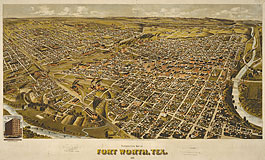
The Amon Carter’s collections are accessible to some extent through their web site (such as the Texas views exhibit), in their regular exhibitions, through their many scholarly catalogues, and for researchers who can view prints in person with an appointment. The prints collection continues to grow through acquisitions and through gifts, especially via the Amon Carter Print Guild support group. There is a dedicated area of the museum for print exhibits and an exhibition of the museum’s antique Western American prints will open this autumn. Given the quality of the collections and the history of excellence from the Amon Carter, this exhibition should be well worth seeing!

Coming soon, a profile of the director of the Amon Carter, print expert Ron Tyler…

Saturday, April 11, 2009

Library of Congress: Prints & Photographs Division

This is the first of a series of blogs in which I will look at the major American historical print repositories. In any consideration of such institutions, the Prints & Photographs Division (P&PD) of the Library of Congress (LOC) is one which holds a pride of place in terms of both size and quality. The P&PD has about 14 million images, including photographs, fine art and popular prints, posters, as well as art, architectural and engineering drawings. The collection is vast and also international in scope, but it is primarily focused on American subjects. The largest component of the PP&D collection is by far made up of photographs, but the P&PD also has American prints from every period and of every sort, including many prints that are unique examples.

This collection was primarily built by a simple but effective process, for from 1846 to 1859, and then again from 1865 until the present, the LOC has been a national copyright deposit center. During this period, any print copyrighted in this country was supposed to have an example sent in to a copyright deposit center. Prior to 1870, the LOC was one of several copyright deposit centers so many, but not all, prints in this period were sent to the LOC. But then with the copyright law of 1870, the LOC became the only official national copyright deposit center. This law radically changed the nature of the LOC, making it the nation’s greatest repository of the output of American authors, artists, and publishers of all sorts. With that law, the LOC soon became the most comprehensive collection of American prints. It has been estimated that 90 percent of the items in the LOC graphic arts collection were acquired through copyright deposits.

Besides its copyright deposit acquisitions, the P&PD has many other strong collections, for instance it has one of the best collections of British political cartoons, second only to that found in the British Museum. This is because in 1921, the LOC purchased the superb collection of the Royal Library at Windsor Castle, a collection built by George III and George IV. As a complement to the British historical prints, the LOC has probably the finest collection of contemporary prints of the American Revolution, a collection that is comprehensively documented in my partner, Donald H. Cresswell’s book The American Revolution in Drawings and Prints .

The best way to access the collections at the LOC is to go in person, though help is available for those who cannot visit, as explained on the P&PD web site Luckily, the LOC has entered the internet age with enthusiasm and the P&PD has an online catalogue which provides access to about one half of the division’s holdings. Though there are many items not available on-line, this still provides internet access to an impressive number of prints. The on-line entries for the prints contain much useful information, and many of the prints are also illustrated. This P&PD catalogue is definitely one of the best internet resources for antique prints.

Besides the P&PD catalogue, the LOC has developed the “American Memory” web site. I cannot do better than to quote from the LOC as to the mission of this site:
American Memory provides free and open access through the Internet to written and spoken words, sound recordings, still and moving images, prints, maps, and sheet music that document the American experience. It is a digital record of American history and creativity. These materials, from the collections of the Library of Congress and other institutions, chronicle historical events, people, places, and ideas that continue to shape America, serving the public as a resource for education and lifelong learning.

As stated, the American Memory website exhibits many items besides prints, including a fair bit of photographic and cartographic material, but prints are well represented. Almost every theme on the site contains some exhibits with some prints, but of particular note are the exhibits on Panoramic Maps (bird’s eye views), African-American sheet music, and Broadsides and other printed ephemera.

Thursday, March 26, 2009

Antique Prints on the Web: Blogs

One of the subjects which I will post about on a regular basis is that of web sites that have relevance to antique prints. As the Antique Prints Blog is a brand new blog specifically on that topic, I will first look at blogs where antique prints are a primary theme. I am, however, not going to cover commercial blogs. Many blogs related to antique prints are simply vehicles to post listings of items for sale or special sales events. There is nothing wrong with such blogs, of course, but as stated in my first post, this blog “is intended to be a non-commercial blog for the education and enjoyment of anyone interested in antique prints.” I will not hesitate to include links to the Philadelphia Print Shop web site, and of course I hope that my business will benefit from its existence, but the rule I will follow is for this blog to be primarily non-commercial. Thus I am going to discuss only blogs that I consider also to be primarily non-commercial.

In January of this year, the Printcollector started a blog entitled Collecting Antique Prints and Maps. His/her intent for the blog states that it was designed to be “for the benefit of antique, rare, scarce prints and maps collectors.” This blog would thus be very similar in intent and subject to the Antique Prints Blog and so it is worth keeping an eye on it. However, the only post so far is the initial, introductory one from January 5, 2009.

A much more active blog is Neil Street’s First Printing: The Antique Maps and Antique Prints Blog which he has maintained since the end of 2005. Neil regularly makes posts which contain listings of meetings, exhibitions and other events related to antique maps and prints. He also lists map and print auctions and antiquarian bookfairs. These lists cover both North America and Europe. This is an excellent blog to follow if interested in these topics, as Neil keeps the list current and impressively comprehensive. (Anyone who is organizing such events should make sure to send him a notice).

John Ptak has a very interesting blog, The History of Ideas--unusual connections in the history of science, math, art and social history John’s business involves books, pamphlets, manuscripts and prints in the sciences and the history of science, and his blog seems to cover the same territory. Scattered in among his 562 posts (as of today) are many interesting essays that relate to antique prints (and maps). These are not that easy to find, but he does include a partial index. A fun and interesting blog to explore.

While maps are only a secondary theme for this blog, I want to mention the excellent Map the Universe, a blog about antique map collecting. Begun in July 2006, this regularly updated blog contains posts on every imaginable topic of interest to those who collect antique maps. I highly recommend this blog and hope that I can make Antique Prints Blog close to as good as Map the Universe.

Finally, there is Marty Weil’s first-class blog Ephemera, exploring the world of old paper, which recently celebrated its third anniversary. Ephemera is a closely related or indeed overlapping topic with antique prints, so this blog is worth exploring.

Beyond this I found only a number of blog posts on particular topics, and the aforementioned commercial blogs. The amount of interesting material on most of the blogs listed above has inspired me to make a firm commitment to keep posting on a regular basis so that this blog will one day achieve a comparable quality. Keep tuned….

Wednesday, March 25, 2009

Antiques Prints Blog

I am starting this blog as a place where I can share news and ideas about a subject that provides me with both an occupation and an avocation, and as a forum for those interested in antique prints. The subjects will be somewhat arbitrary, inspired by experiences I have, new prints that come our way, questions we receive from the public, or new books I read. I will also post information on current events and books related to antique prints. The opinions expressed in the blog will be mine and should not be taken as reflecting official positions by the Philadelphia Print Shop nor any organization I am a member of. This is intended to be a non-commercial blog for the education and enjoyment of anyone interested in antique prints.

The theme of the blog is “antique prints,” and by that I mean to focus on original prints from the seventeenth to early twentieth century. I am using “original print” in the sense described in the Print Shop's on-line reference library as a print where the matrix was produced by hand, as opposed to by some photomechanical process. While I will not rule out any topics within this broad spectrum of prints, I will focus on historical prints from the eighteenth and nineteenth century, and more often than not on American subjects. The topic of antique maps might also appear from time to time. The subjects of the blog will reflect my personal biases, but if a reader would like me to post on a particular subject, I will certainly consider any suggestions.

So why start such a blog? I have a professional and personal desire to spark interest in and spread knowledge of antique prints, and in today’s world a blog seems to be an efficient way to do this. I have reasonable credentials to write a blog on antique prints, as I have been a print seller and researcher for over 25 years, and I have written and lectured extensively on the subject. Also, at the Philadelphia Print Shop I come into constant contact with a wide variety of different types of prints, people with extensive knowledge and different ideas, and much research from books and magazines, and so I am well positioned to be able to share this experience. Finally, I going to maintain this blog because I love what I do and it is fun to share with those who share my enthusiasms. I hope this blog will be interesting and enjoyable for its readers.

Among the topics I plan to include in the blog are

  • Thoughts on print subjects that interest me
  • Descriptions of unusual prints we come across
  • Answers to questions we are asked by clients and the general public through our web site
  • Announcements and a listing of print events
  • Announcements and comments on new print reference books & articles
  • Profiles on important print collections in North America
  • Anything else print related I think interesting (please send suggestions!)

I will keep the blog as up-to-date as possible, with a minimum of a new post a week. Comments on the posts are welcome, though I will require a reasonable level civility and profanity will not be allowed. Please remember that this is a web blog, not an academic tome, and so there will inevitably be mistakes, conceptual and grammatical. In order to keep the posts coming on a regular basis, I cannot check and recheck everything I write. I will try to be as accurate as possible, but corrections are always welcome. Finally, I encourage readers to send suggestions for topics, send me questions I can answer on the blog, and keep me informed on new articles & books and forthcoming print events. You can email me at philaprint@philaprintshop.com