Showing posts with label mapmakers. Show all posts

Wednesday, February 23, 2022

Four Great Surveys of the American West

After the Louisiana Purchase, the U.S. Government was interested in trying to get a basic understanding of what was in the vast new lands the country had acquired. Towards that end, the government sent out a number of surveys in the early nineteenth century. These included the Lewis & Clark expedition of 1803-1806, Zebulon Pike’s of 1806-07, and that of Stephen H. Long in 1819-20.


The Long expedition ended the official exploration of the West for about two decades, until finally in 1838, the U.S. Army established the Corps of Topographical Engineers, the purview of which included exploring and mapping the West. Among the most important of their surveys were the five expeditions led by John C. Frémont between 1842 and 1853.


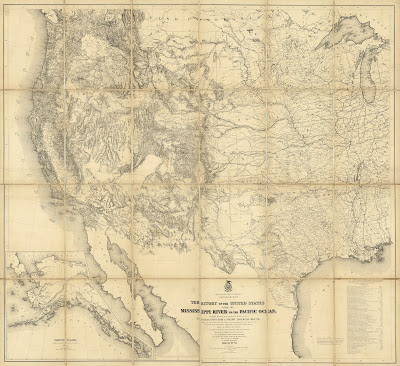
After mid-century, exploration of the West picked up significantly when in 1853 Congress authorized $150,000 for the exploration of possible railroad routes across the continent, creating the Pacific Railroad Surveys to investigate possible routes across the West at four different latitudes. The results of these surveys were depicted in G.K. Warren’s important “Map of the Territory of the United States from Mississippi to the Pacific Ocean,” which summed up the government’s understanding of the West on the eve of the Civil War.


After the Civil War, the nation turned its attention even more to the American West, which was seen as an area of huge potential economic development. This led to a demand for better information on the region, a demand that was partially met by the General Land Office. The GLO was responsible for the surveying, platting and sale of public lands, so while their surveys were very important for the economic development of the West, there were large sections of the region they did not cover.


The Federal government was particularly interested in the economic resources of the West, which had not been a focus of the earlier military surveys. Thus, the government modified its surveys so that were more scientific, rather than military. These were called “geological” surveys, “geology” at the time having a wider definition than now, referring broadly to the science of the earth, including within its compass botany, soil science, archaeology and anthropology.


The first government survey dedicated to studying the geological, and thus economic aspects of a far western state was the 1860-74 California Geological Survey led by Josiah D. Whitney. This survey is important for several reasons, not the least of which was the new procedure for surveying alpine landscapes developed by its lead topographer, Charles Frederick Hoffmann.


The California Geological Survey established the methods and aims for future surveys by the U.S. Government, which in 1867 authorized the first in a series of systematic scientific surveys of the West. These became known as the “Four Great Surveys,” which ran pretty much concurrently and lasted until 1879.


King Survey (1867-73)
The first of these surveys, authorized on March 2, 1867, was the U.S. Geological Exploration of the 40th Parallel, led by Clarence King, who had worked on with the California Geological survey. The purview of the King party was to survey the lands on either side of the Pacific Railroad from California to eastern Wyoming and it was designed primarily as a practical survey to determine the economic potential of the lands along the railroad route.


The King survey resulted in the publication of a Geological and Topographical Atlas in 1876. This included a general map, then five each of topographical and geological sectional maps in sequence along the route of King’s survey. The maps were done in very large size—most sheets measure 29” x 42”—these are rare and fascinating images of the western part of the lands on either side of the 40th parallel.


Hayden Survey (1867-79)
The second of the Great Surveys began the same year as the King survey. This was led by Ferdinand V. Hayden and though it started off focused on Nebraska, within two years it became the U.S. Geological and Geographical Survey of the Territories. Hayden’s survey eventually encompassed parts of Nebraska, Wyoming, Idaho, Montana, and particularly Colorado.


Hayden issued yearly reports and these standardly include illustrations as well as maps of the different areas he surveyed. The most impressive of his cartographic publications was the 1877 Geological and Geographical Atlas of Colorado, which included four general maps of the entire state, as well as topographical and geological maps of the state broken into six sections. These provide the first comprehensive and accurate mapping of the Colorado, just a year after statehood.


Powell Survey (1870-78)
The third of the four Great Surveys was the U.S. Geographical and Geological Survey of the Rocky Mountain Region led by John Wesley Powell, a survey which lasted from 1870 to 1878. Powell had become convinced that the Colorado River canyons could be explored only by boat, so in 1869, Powell formed a private expedition and set off down the Green and Colorado Rivers. The expedition members are the first known Euro-Americans to traverse the Grand Canyon.


As the 1869 expedition ended up being more about survival than science, and as much of the data he had gathered was lost, Powell asked Congress to authorize another exploration of the Grand Canyon. This Congress did with the creation of the third of the Great Surveys, the scope of which was not only the Grand Canyon, but also the surrounding plateau lands. Powell was involved in the production of a number of maps, some of which appeared in reports from this survey, but there was no major cartographic publication which resulted.


Wheeler Survey (1872-79)
The last of the four Great Surveys was under the command of Lieutenant George Montague Wheeler. Wheeler had led surveys in eastern Nevada and Arizona in 1869. These were under the aegis of the U.S. Army’s Corps of Engineers and the surveys had primarily military objectives. By 1870, with the creation of the other three, essentially civilian surveys, the military became concerned that the job of mapping the American West was being taken away from them. Wheeler came up with the idea of having the Army survey the entire country west of the 100th meridian. The Army bought into this concept and convinced Congress that this was a good idea, so in 1872, money was appropriated to form the U.S. Geographical Survey West of the 100th Meridian.


Wheeler was never able to complete his work, though he did map a large portion of the West by the end of 1879, covering about 360,000 square miles, though that was only about on quarter of the area originally intended. Beginning in 1876, Wheeler issued a number of maps, along with a title page for a “Topographical Atlas.” The idea was that Wheeler would issue maps as the survey progressed, with the sheets eventually all gathered into this atlas. This did not happen; the intended atlas was never completed. Over the years, however, Wheeler did continue to produce maps, most sheets showing one quarter of one of his 95 quadrangles. Each year Wheeler also produced a progress map illustrating the areas that had been surveyed. Wheeler stopped surveying in 1879 but continued to issue reports and maps until 1884.


In the end Wheeler produced 71 topographical maps. Initially he was criticized for not showing enough information about the natural resources of the areas mapped, so Wheeler started to add economic or land-use maps, as well as some geological maps. Craig Haggit, of the Denver Public Library, has produced a very nice web page about the Wheeler maps, which can be seen by clicking on this link.


Competition between the surveys
It is not really surprising that right from the beginning there was competition between the Four Great Surveys, as they ran pretty much concurrently and covered overlapping areas of the West. There was a conflict between the military and civilian surveys, the military wanting to have authority over the western surveys and the scientific community wanting the same thing. There was also conflict over getting money from Congress, as there were limited funds and each survey wanted to make sure they received sufficient appropriations. Finally, there was conflict over the scope of each survey. For instance, at one point Powell tried to extend his survey to encompass the entire Rocky Mountains, but Congress demurred, saying the Rockies belong to the Hayden survey.


The most consequential of the conflicts was between Hayden and Wheeler, whose territories did overlap. This came to a head on July 9, 1873. Wheeler had sent a party, under Lieutenant W.L. Marshall, to survey south-central Colorado and at the same time Hayden had sent one of his survey parties into the South Park area, which was just where Marshall was working.


Hayden describes what happened:

“As we were riding down into the south Park, about the 9th day of July, we came across Lt. Marshall’s party and we camped together. He was a very courteous gentleman and we were very friendly. We talked matters over, and some regrets were expressed that we were on the same ground. I simply stated to him...that I had no option but to perform this work and we had had the Territory of Colorado assigned to us as a field of exploration. He simply said that he was under orders, and therefore could not disobey his orders.”
As a result, both parties set about surveying the same area in a ridiculous duplication of effort.


It was inevitable that this conflict would come to the attention of Congress. This happened when the War Department demanded an investigation in hopes of asserting its authority, through the Wheeler survey, over all the surveys of the West. As a result, the following year, the Townsend Committee on Public Lands of the House of Representatives met to consider the conflict.


One tack taken by the military was to attack Hayden personally. Marshall accused Hayden of rushing into the area specifically to preempt Wheeler (which may or may not be true). Also, supposedly, as reported by Wheeler’s geologist, Hayden was quoted as having said, “You can tell Wheeler that if he stirs a finger or attempts to interfere with me or my survey in any way I will utterly crush him—as I have enough congressional influence to do so and will bring it to bear.”


Despite these attacks, Wheeler and the military were for the most part on the defensive, as the entire scientific community backed Hayden. Wheeler’s process and maps were assailed, with Hayden’s worked stated as being much better. However, Wheeler had the backing of President Grant and in the end the Congressional committee did nothing, concluding that “there is an abundance of work for the best talents of both the War and Interior Departments in the scientific questions of the Western Territories for many years to come.” Still the committee did reprimand Hayden and Wheeler for “ill-judged and hasty expressions...which good taste would have withheld.”


The problems of having so many concurrent government surveys in much the same area persisted. The concern over this was aggravated by the rising costs of the surveys, so in the spring of 1878, the House Committee on Appropriations undertook to see if the surveys could be consolidated and condensed. At this stage, the King survey was already done, but Hayden, Powell and Wheeler were all still in the field.


In the end Congress decided that the General Land Office was to continue to survey public lands, the Coast and Geodetic Survey would continue to do “first-order triangulation of the whole country,” but a new “U.S. Geological Survey” was to “assume all surveying, mapping and geological investigations in the West.” As a result, on March 3, 1879, the U.S. Geological Survey was established, replacing the remaining three Great Surveys and beginning a new chapter in the surveying of the American West.


Wednesday, August 28, 2019

Abraham Ortelius

Abraham Ortelius (1527-1598) is often called the ‘father of modern cartography,’ particularly because in 1570, he issued the first edition of his Theatrum Orbis Terrarum, which is considered the ‘first modern atlas.’ The publication of this atlas marked an epoch in the history of cartography, for it is the first uniform and systematic collection of maps of the whole world based only on contemporary knowledge since the days of Ptolemy.


Ortelius began his career as an engraver and “peintre des cartes,” (map colorist), eventually becoming a dealer in maps and books. As such he met and befriended the great Gerard Mercator and began to produce as well as sell maps in Antwerp in 1561, starting with an eight sheet world map. In the sixteenth century there was a great increase in interest in maps and charts, and Ortelius, as a businessman with a passion for history and cartography, was at the forefront in meeting this demand. Through his collecting and his antiques business, Ortelius became acquainted with a large network of the preeminent cartographers in Europe and thus was able to research the best contemporary maps, becoming the greatest expert of his day in the bibliography of maps.


He decided to produce an atlas of the entire world, the Theatrum Orbis Terrarum, or 'Theater of the World,' done on a systematic basis in a uniform style, beginning with a map of the world, then maps of the continents, followed by regional maps. Ortelius based his work on the best maps available, drawing all the maps himself with the celebrated Frans Hogenberg cutting most of the plates. Unlike other atlas-makers, Ortelius cited the authors of the original maps from which he compiled his work. The result was that his maps were some of the most attractive and accurate of the late sixteenth century.


The Theatrum was hugely popular and influential, and Ortelius was made the royal geographer to Phillip II, expanding his atlas with new maps, and in 1579 to include the Parergon, a historic atlas intended to supplement the Theatrum. When he died in 1598, the Theatrum had been published in 25 editions in five editions, with two other languages added after his death. Thus it is not only for his unprecedented achievement in issuing the first modern atlas, but also for his thoughtful and rigorous methodology, that Ortelius belongs amongst the first rank of cartographers.


Monday, February 27, 2017

Sebastian Munster

Sebastian Munster (1488-1552) was one of the most influential mapmakers of the sixteenth century. He was born in Hessen, Germany, studied in Heidelburg and Tübingen, and finally settled in Basle, where he lived the rest of his life. Munster was a cosmographer, theologian, mathematician, professor of Hebrew, and geographer. His output included separate sheet maps, maps for other’s publications, but he is best known for his many editions of Ptolemy’s Geographia, beginning in 1540, and of his own Cosmographia, beginning in 1544. These volumes were very popular and influential, running through many editions, with the latter published until well after his death.


Claudius Ptolemy was the librarian at Alexandria in the Second Century A.D. who wrote two major works, one of which, the Geographia, was the first world atlas. It consisted of Ptolemy’s compilation of all known geographic information, including instructions for how to make maps. Rediscovered in the middle ages, Ptolemy’s Geographia had a huge impact on man’s understanding of the world. Such was this influence that even in the sixteenth century, when Ptolemy’s geographic conceptions were known to be wrong, maps based on his depictions were issued time and again.

Munster’s edition of the Geographia, contained 48 woodcut maps, including the Ptolemaic maps of the world and its parts, to which Munster added “modern” maps showing the latest information available in the first part of the sixteenth century. Thus for both the world map, and many regional maps, Munster included a geographic image which was 14 centuries old and one which was “up-to-date.” Other geographers did this as well, but Munster was innovative in being the first to include a separate map of each of the four known continents, a feature of atlases which soon became standard.

Munster’s Cosmographia was a compendium of all the information he felt important about the cosmos, featuring details on the history, flora and fauna of all parts of the known world.

Page from Cosmographia


The work included woodcut views and maps of countries and cities around the world, and it is filled with a multitude of small woodcuts showing portraits, animals, plants, sea monsters, and much else.


Ptolemaic World

So, let's look at some of Munster's output... Above is the Ptolemaic world map from the Geographia. It shows the typical artistic design of Munster's maps, in this case with the twelve "winds" shown around the edges. The map shows the world as the ancients thought it was in the time of Ptolemy, so there is no "New World," just Europe, Asia and Africa. Note that Africa connects with Asia along the bottom of the map, making the Indian Ocean landlocked.

Modern World

Look at the difference in this map, which shows the world as understood in 1540! The Americas are shown and Africa now has approximately the right shape. Still, the map has its echos of the past, still showing the winds around the edge, and its oceans filled with sea monsters. It is fascinating to realize that both of these maps were issued in the same atlas!

Ptolemaic Italy

This double imaging of places happened not just for the world, but also for regions. Here is Munster's map of Italy, as known in the time of Ptolemy--in this case quite accurate as much was known of the peninsula in ancient times.

Modern Italy

The map above was issued in the same atlas as the map above, with no comment made about which is better.

New World

As I mentioned above, Munster was the first to include separate maps of all the known continents, such as this map of the Americas. This map is even more important, as it is the first time the "New World" had been shown in a map as a single landmass. The map is a delight, with a great representation of the cartographic myth of the "False Sea of Verrazano"--that curious indentation in the northern part of North America--, as well as showing Magellan's ship, the Victoria sailing across the Pacific Ocean and including pictures indicating the cannibals of the New World.

View of Heidelberg

The views of the cities in the Cosmographia, on the other hand, were all modern renderings, mostly based on first-hand knowledge. These are some of the earliest, and most decorative, views of European places.

Munster's Monsters

I cannot do a blog about Munster without mentioning my favorite of all his work, his compendium of Sea and Land Monsters. Here Munster shows all the known monsters of the world, including those of the oceans and of the ‘unknown’ lands beyond the edge of civilization. While most intellectuals of the late sixteenth century treated the existence of these monsters with skepticism, many still believed in their existence and the issue was certainly not completely decided. As Munster’s Cosmographia was a description of the whole world, this print of monsters was needed to make the work complete. Across the top of the image are the land creatures, including a gluttonous bear. Below are the “Sea Wonders.” We are most fortunate that Munster included the print, for it offers us a unique glimpse of Renaissance attitudes towards those ‘unknown parts’ of their world.