Showing posts with label Interesting prints. Show all posts

Wednesday, April 1, 2020

Thomas Doughty, Printmaker

While Lucien Bonaparte was finishing Alexander Wilson’s American Ornithology, and John James Audubon was beginning his great projects, John and Thomas Doughty produced a book, Cabinet of Natural History and American Rural Sports with Illustrations, that is important both for its many anecdotes about the social impact of natural history and sport in America, but also as the first major book illustrated with color lithographs produced in America.


Though the joint publication of the Doughty brothers, the prints in the work were primarily the offspring of Thomas. Thomas was evidently a self-taught artist, listing himself as a “painter” in the second decade of the nineteenth century, one of the first Americans to list this as an occupation. In the next decade about 40 of his images were used for a variety of publications, but then Thomas, who was an avid outdoor sportsman, conceived of the notion of a color plate work illustrating the natural history of American rural sports. This led to the Cabinet of Natural History and American Rural Sports with Illustrations, where his output reached a new level of vision and quality.


The work, issued in monthly parts, began in 1830, but things changed as the production on the third volume began. At that time, Thomas Doughty left the project to pursue a painting career, gaining immortality as a founder of the Hudson Valley School of painters. His brother, John, took over as sole proprietor, but he soon warned his subscribers that unless he received more support he would have to end the project. This was proved true in 1834 when he discontinued publication with part IV of the third volume.


The first print is an engraving by John Sartain of the “Common Deer,” one of the works done in America by this noted engraver. The rest of the prints were done in the relatively new process of lithography. The artists who produced images for the work were some of the luminaries of the Philadelphia art scene, including M.E.D. Brown, George Lehman, J.G. Cloney, but the major contributor was Thomas Doughty himself. Of particular note are the prints by Titian Ramsay Peale, who upon his return from the Stephen Long expedition to the American West made pictures available of this new American frontier, including his famous image of hunting the American buffalo.


Tuesday, December 17, 2019

Fort Wicked

With the growing emigration of white Americans from “the States” to the Rocky Mountains and beyond in the 1860s, the Plains Indians found their traditional way of life fading. Not only did the emigrants eat up local resources, and kill many buffaloes, but the U.S. government began a systematic attempt to limit the Native Americans to limited reservations. Frustration led to sporadic Indian raids on emigrant trains and settlements, culminating in a number of “massacres” in the summer of 1864.


This prompted Colorado territorial governor, John Evens, to demand that all “peaceful” Indians to report to a number of military posts. Despite this, a peaceable group of Cheyenne was turned away from Fort yon and told to camp near Sand Creek, just to the north, where they would supposedly be safe. Unfortunately, Colonel John M. Chivington, commander of the First Colorado Regimen, believed he needed to “teach the Indians a lesson they would not forget, and he attacked the peaceful Indian camp, killing every man, woman and child possible, with some 150 Native Americans losing their lives in the notorious “Sand Creek Massacre.”


This naturally spurred more Indian braves to seek reprisal, with a number of raids along the Platte River emigrant route, to the east and west of Julesburg. . Beginning in early 1865, bands of Arapahoe, Cheyenne and Lakota warriors attacked nearly every ranch and station along the route and destroyed the telegraph line connecting Denver with the East. The settlers along the way did why they could, but many died or were captured, and their ranches burned to the ground.


One ranch owner, Holon Godfrey, decided to defend his home, located between today’s Sterling and Fort Morgan, as best he could. His ranch included a tower with portholes and he dug a well inside his defenses. In January 1865, Godfrey was raided, supposedly by about 200 Indians, but with the help of a visitor, his wife and children, he was able to repel the attack. As a result, the Indians called Godfrey “Old Wicked,” a name he liked enough to christen his ranch “Fort Wicked.” This secure post, about the only remaining settlement along the Platte River route, became a regular stop for the stage lines.


The following year, Harper’s Weekly, the leading American illustrated newspaper of the day, sent a party of report on the on-going Pike’s Peak gold rush. James F. Goodkins was the artist with this party and on October 13, 1866, Harper’s published a multi-panel print showing scenes from his experiences. The print included two views of Denver, a few scenes from Goodkins’ trip across the plains, and two fanciful illustrations of Indian attacks.


Also included was a small view of “Fort Wicked,” showing its fortified walls, the protected well, and a sign reading: “Fort Wicked. Kept by H. Godfrey. Groceries.” This print is a wonderful example of how the prints from the illustrated newspapers of the nineteenth century can provide us with first-hand images of aspect of our past not documented in any other way.


Wednesday, December 4, 2019

Thomas Nast Christmas Illustrations


Thomas Nast is among the most famous American illustrators of all time, often called the “father of American political cartooning.” Nast was born in Bavaria in 1840 and at six years immigrated with his family to the United States. His father, a musician, had enrolled the artistically precocious child in an art school by age 12. Three years later, Nast was forced to leave his training to help support the family, fortunately gaining work as an illustrator for Frank Leslie’s Weekly. Five years later Nast traveled abroad to cover the Heenan-Sayers fight for the New York Illustrated News, later joining Garibaldi’s forces in Italy as a war correspondent. In 1862, Nast again became a war correspondent, this time for Harper’s Weekly Civil War reporting. His patriotic themes created such attention that President Lincoln cited Nast as his ‘best recruiting sergeant,’ and General Ulysses Grant remarked that Nast “did as much as any one man to preserve the Union and bring the war to an end.”


In the years after the War Between the States, Nast became the most significant illustrator of American political and social issues. His pointed cartoons exerted a great impact on public opinion. Every presidential candidate to gain his support won and his stature increased with the successful campaign in 1870-71 to bring down “Boss” Tweed of New York’s corrupt Tammany Hall and his political machine. More than a mere cartoonist, Nast was an innovator of images, popularizing or instituting many now familiar subjects such as the Republican elephant, the Democratic donkey, John Bull, Uncle Same, and Columbia.


Perhaps his most lasting creation was the image of Santa Claus he developed in a series of cartoons in Harper’s Weekly from 1863 to 1886. Inspired by the description of St. Nicholas in Clement Moore’s 1823 poem ‘Twas the Night Before Christmas, Nast developed his image by using his own beard and rotund belly to eventually create the “jolly old elf” which is our present day image of Santa Claus.


The first image of Santa by Nast was a cover illustration of “Santa Claus in Camp” on January 3, 1863, as well as cameo appearance in the corner of a double page “Christmas Eve” image. At this time Santa was fairly roly-poly and had a long beard, but the theme was more related to Santa’s support of the Union cause-—note the stars and stripes on his costume and he holds a puppet of Jefferson Davis with a noose around his neck.


As time went on, further developed his image, turning Santa into the figure we recognize today. He showed Santa with a workshop at the North Pole, and keeping track of children and their hopes for toys at Christmas. Overall, Nast created 33 cartoons of Santa, the last as a cover image for the December 25, 1886 issue of Harper’s Weekly. After that Nast severed his relationship with Harper’s, but fell into considerable debt through bad investments. In 1901, Theodore Roosevelt was elected President, and wanting to help out the man who had done so much for the country, he appointed Nast as Consul General in Ecuador. Nast died a year later of yellow fever.


Click here to see a selection of Nast Christmas iamges


Monday, January 28, 2019

Giovanni Belzoni's images of Egypt

Giovanni Belzoni (1778-1823) was a nearly six foot, seven inch, red-headed Italian whose fascinating life led him to become known as “The Great Belzoni.” As a young man in Rome, studying hydraulics and intending to join a monastic order, Belzoni was driven from the city when it was captured by Napoleon in 1798, moving to the Netherlands where he worked as a barber.


In 1803 he moved to England (supposedly to avoid being thrown into prison), where he became a circus strongman called the “Patagonian Samson.” Part of his act was to carry a dozen men around the stage on a metal frame.


In 1816, Belzoni traveled to Cairo in order to interest Mohammed Ali Pasha in a hydraulic lifting device that he had invented. This venture proved unsuccessful, but Belzoni became fascinated by Egypt. He turned to the British Consul, Henry Salt —-who had known him during his time as a strongman—- for possible employment. Salt, who was facing the problem of getting the head and shoulders of the colossal statue of Ramses II (called the “Younger Memmon”) from Thebes to England, hired Belzoni for this job.


Belzoni was able to complete this task with ingenuity and perseverance. The head weighs over 7 tons and it took Belzoni 17 days and over 100 men to tow it on a wooden sled to the Nile. (The statue is now in the British Museum).


Belzoni continued his “collecting” of Egyptian artifacts and explored many of the important sites in the country. In 1817, he became the first to perform large scale excavations in the Valley of the Kings, discovering a number of tombs, including those of Amenhotep III, Ramses I, and Seti I, the latter often called “Belzoni’s tomb” in honor of his discovery.


He was the first person since ancient times to enter the innermost part of the great pyramid of Khafre at Giza, though at one point he became wedged in a narrow passage, having to be extricated by his helpers.


Belzoni also was the first to excavate the great temples at Abu Simbel, which were buried under 30 feet of sand.


Belzoni made many enemies and stole many artifacts from Egypt (though he was only one of many Europeans doing the same thing). He also did some cringe-worthy things, such as smashing through a wall with sledge hammers, sitting on mummies so they were crushed underneath his weight, and carving his name on ancient monuments. Still, Belzoni’s enthusiasm and energy allowed him to “achieve” much. He approached his explorations with enthusiasm, mounting excavations on a massive scale, and he was highly systematic in his approach. He destroyed much, but was instrumental in awakening Europe to the glories of ancient Egypt.


After returning to England in 1820, Belzoni published his famous Narrative, a work that excited huge interest. In 1822, the atlas of prints to accompany this work was issued, containing many detailed scenes of sites in Egypt


and brilliant renderings of the tomb paintings that Belzoni discovered. Such was the impact of Belzoni’s publicizing of his discoveries that this can be seen as the beginning of the popular fascination with Egypt.


After Egypt, Belzoni continued his explorations in Africa, heading an expedition to Timbuktu in 1823. He caught dysentery there and died at the end of that year.


Wednesday, May 2, 2018

The Arkansas Traveler

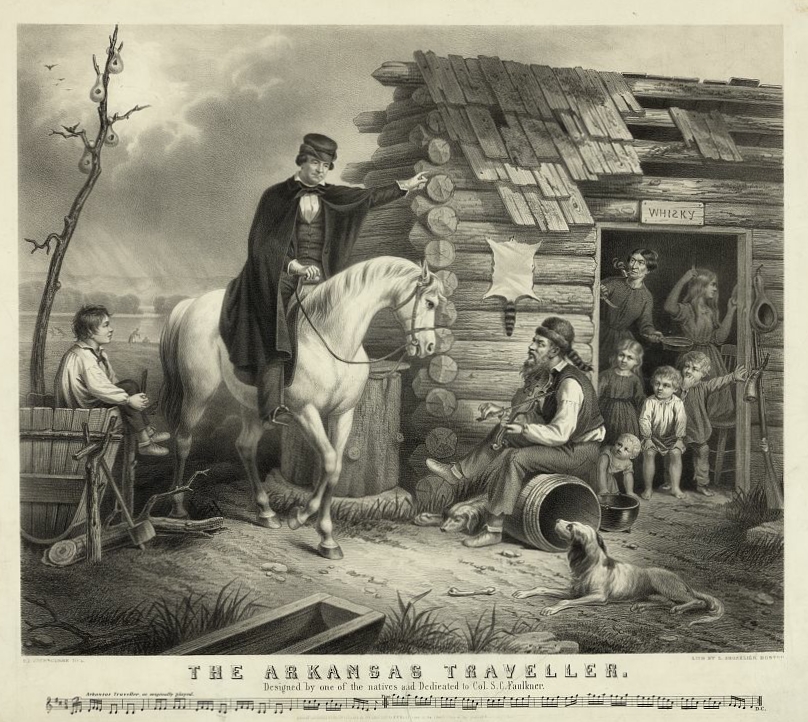
The story of the “Arkansas Traveler” naturally has its roots in Arkansas, but over time it has come to be a universal American folk tale. The origin of this tale is in a story recounted by Colonel Sanford Faulkner, an Arkansas farmer and politician. According to his telling, Faulkner got lost somewhere in the Ozarks in 1840 while on a political canvasing trip. Searching for directions, Faulkner came across a ramshackle squatter’s cabin with its occupant sitting outside playing his fiddle.


Faulkner's queries to the squatter were met with humorous but unhelpful replies until Faulkner showed he was able to play the second “turn” of the tune the squatter had been playing. This thawed the squatter’s attitude, and he subsequently offered welcome hospitality and directions to Faulkner.


The tune supposedly played in this perhaps apocryphal episode probably had older roots in American folk music, but it was first published in 1847, and it went on to become a standard part of the American folk repertoire. The story later became part of a popular sketch performed regularly on the vaudeville circuit, featuring a lost city slicker as the brunt of evasive banter by a cagey country fiddler.


In the mid-1850s, Arkansas artist Edward Payson Washbourne made a painting of the meeting between the traveler and fiddler, which in 1859 was turned into a lithograph by J.H. Bufford. That print is very rare, but a number of years later, Currier & Ives issued their own version of this scene and it is that print which has come to be the iconic image of the Arkansas Traveler.


One of the things I enjoy most about the print/map business is that I share a love for the items I deal in with many others. Often, those fellow enthusiasts share their enjoyment and knowledge with me. This recently happened where a fine banjo player, Don Borchelt, sent me this link to a delightful rendition of the tune, as well as a fun version of the dialogue between the traveler and fiddler, using—-naturally—-the Currier & Ives print as illustration.


Monday, March 19, 2018

John Reps on American Bird's Eye Views

I just wrote about the excellent exhibit on Fowler's bird's-eye-views of Pennsylvania towns which is at the State Museum of Pennsylvania (as well as on line). One thing which I didn't mention was the excellent slide-show presentation on the general subject of American bird's-eye-views put together for the exhibit by John Reps.


John Reps is the dean of scholars on this topic. His classic Views and Viewmakers of Urban America is the "bible" on the subject, not only because of Reps amazing listing of thousands of these views, but also because of his insightful text on the views and their makers. Well, John added to this story in a very interesting slide show which can be seen on the internet. It talks about how the prints were made and includes some fascinating images that I have never seen. Anyone interested in this topic should take a look!


Tuesday, March 13, 2018

T.M. Fowler's Bird's Eye Views

I recently heard of a wonderful exhibit at the State Museum of Pennsylvania which I am happy to call to everyone's attention. A description of the exhibit is given on the exhibit web site:


‘Every Thing of Interest Shown’: T.M. Fowler’s Bird’s-Eye Views of Pennsylvania, 1885-1905, on exhibit through May 6 on the first floor of The State Museum, showcases a series of bird’s-eye views, or panoramic maps, of Pennsylvania communities as they appeared during the late 19th century.


Urban bird’s eye view of the nineteenth century are one of the most interesting type of American prints there are. Beginning after the Civil War, the bird’s eye view became one of the most popular of print genre, with these prints being made of thousands of American towns and cities from the late 1860s into the early twentieth century. This was a period of significant urban growth throughout the country, and the civic pride which proliferated provided a fertile field for print publishers to market these visual vistas of America. According to John Rep’s seminal Views and Viewmakers of Urban America, publishers sent their artists out into the field throughout all parts of the country to draw and market the views. The artist would walk the streets of the town or city, drawing all the buildings and encouraging the citizens to subscribe to the view that would be produced. Once the entire area was sketched and enough subscriptions obtained, the artist would use a standard projection to turn his street-level images into a bird’s eye view.


Because these views were primarily sold to citizens of the place depicted, they had to be accurate and all buildings shown, lest an owner were to be insulted. The relative size of buildings might be off, some physical features might be exaggerated (for instance the size of a river might be increased to emphasize its importance), or a building not-yet-built might be inserted so the view would not be out-of-date as soon as it was issued, but on the whole the views were amazingly detailed and accurate. Thus these views are not only highly decorative, but are also remarkable historical documentation, providing us with a wonderful documentation of nineteenth century urban America.


Thaddeus Mortimer Fowler (1842-1922) was the most prolific of all American bird’s eye view makers. Fowler served in the Civil War and was wounded at the Battle of Bull Run. That led to a discharge, but Fowler kept involved with the army by making tintypes of soldiers. He later moved to Madison to work for his uncle, a local photographer. Fowler began his career with bird’s eye views about 1868 by working as a subscription and canvassing agent for Albert Ruger of Chicago. Fowler soon came to work also as an artist of the views, making the sketches and preparing the final drawings. By 1870, he set up as his own publisher and from then on he acted as both artist and publisher on many prints, sometimes on his own and sometimes with others.


Over the years, Folwer was involved in over 400 different views! He worked right up to 1922, when at age seventy-nine he slipped on the ice in Middletown, N.Y., where he was undoubtedly promoting a revised view of the city which was planned for that year. Fowler made his first view of Pennsylvania, of Altoona, in 1872, subsequently making more that 240 more views of the Keystone State, more than half of his output. As noted on the State Museum web site, because of this Pennsylvania has more bird’s eye views than any other state.


The State Museum exhibit is well worth visiting by anyone who is interested in bird's eye views or Pennsylvania history. The web site is also excellent, presenting much information and lots of images. The State Museum, along with the Library of Congress, have digitized many of Fowler's prints, shown both in the exhibit and in this blog.


Thursday, December 21, 2017

Appreciating (some) religious prints

I have been in the print and map business for three and a half decades, getting into the business because of my love of history and graphic images of that history. Initially, I focused on early maps—-from the age of exploration-—and historical prints showing scenes of events in the past. Even after all these years, I still love this business and enjoy researching, writing and lecturing about old maps and prints and their place or role in history.


One of the things that amazes me is that I still regularly come across new items which I have either not handled before or which I didn’t even know about. This is always an exciting thing and I will spend days researching and writing up a description of the new item both for my enjoyment and for the edification of our clients.


The latter point is a central policy of my business. Ever since I started The Philadelphia Print Shop with Donald H. Cresswell, our company policy has been to present everything for sale with documentation which places the items in their historic context. We believed in 1982, and I still believe today, that understanding the history of an old map or print is essential for its true appreciation.


One of the things that this approach has done is from time to time to allow me to come to appreciate prints which I used to dismiss as uninteresting. This still happens, as was proved just recently with a new group of prints we got in our shop which I was not even going bother to put on our web site. However, I decided I really should put them up on our web site and so I had better do some research and write them up.

The prints in question are religious prints, a type of print most print dealers, including me, usually dismiss pretty much out of hand. The reason for this is not that print dealers have a prejudice against religious prints, but that i) there are more religious prints than any other kind of prints, ii) most religious prints were done in large numbers without a lot of care for quality, and iii) antique religious prints generally have little market value.


Actually, there is, and has long been, a considerable demand for religious prints by the general public. These prints which hang in many homes around the world. However, that demand means that ever since prints have been made, there have been printmakers creating large numbers of prints to meet that demand. The demand, especially today, is generally not for high quality prints, but rather inexpensive prints with a strong impact. Thus most religious prints are not of the best quality, though there were far more top quality religious prints made in the 18th century.


So, all that explains that when we acquired a group of uncolored engravings of scenes from the bible, I was underwhelmed. That changed, however, when I began to research the prints. These prints are from what is called the “Macklin Bible.” This was a project produced by London print and book publisher, Thomas Macklin between 1792 and 1800.


Macklin decided to produce the largest England Bible ever printed, which took almost a decade and cost about 30,000 pounds! Of particular note is that he decided to include 70 large engravings based on paintings commissioned from a number of important artists, including Philippe Jacques de Loutherbrough, Joshua Reynolds and Benjamin West, and engraved by the best English engravers.


Macklin said the publication was to promote "the glory of the English school' of painting and engraving and 'the interest of our HOLY RELIGION." Macklin died on October 25, 1800, before the Bible was completed, but he did manage to see the last of the engravings, which was finished on October 20th, 1800.


Once I read up on this work, I looked again at the prints, and they came alive for me in a way that my initial, cursory look totally missed. While the subjects are all familiar, the images are special, with each of the artists taking a unique and inspired take on the subject selected. The engraving quality is also superb. I must say I was really surprised, but I actually became engaged with a group of religious prints!


The moral of the story is that almost all old prints and maps are “special” in their own way, and that the only way to truly appreciate them is to study their history and try to understand them in their original context.