Friday, May 29, 2009

Ewell L. Newman Award

At the recently held American Historical Print Collectors Society (AHPCS) annual meeting in Portland, the 2009 winner of the Ewell L. Newman Award was announced and I am really pleased that the award went to Panorama of Pittsburgh, the book on 19th century printed views of the city which I authored.

The Ewell L. Newman Award has been awarded yearly since 1989 by the AHPCS in order to recognize and encourage outstanding publications enhancing appreciation of American prints before 1900. As described by the AHPCS:
Small and large works, those of narrow scope and those with broad general coverage are equally considered. Original research, fresh assessments, and the fluent synthesis of known material will all be taken into account. The emphasis is on quality and on making an outstanding contribution to the subject. Exhibition catalogues, monographs, articles, and works based on local sources are eligible.

Panorama of Pittsburgh served as the exhibition catalogue for an exhibit held at the Frick Art & Historical Center in Pittsburgh from June to October, 2008. This was the most comprehensive exhibit of printed views of Pittsburgh ever produced and it was selected as one of the best 2008 exhibitions in Pittsburgh by both major city newspapers.

The catalogue, Panorama of Pittsburgh contains color images of all the items in the exhibit, and the thematic essay begins with images of Pittsburgh before the fire of 1845 and progresses through views from books and magazines, prints documenting events, illustrated newspapers, frameable views, advertising, music sheets, and other types of prints.

This book, however, was intended not just as an exhibition catalogue, but also as a long-term reference on nineteenth-century views of Pittsburgh and Pittsburgh printmakers. Thus is provides background information on the most prominent Pittsburgh-based printmakers, a list of Pittsburgh printmakers assembled from period sources and the most encyclopedic list of nineteenth-century prints of the city that has ever been assembled. The Frick produced a beautiful catalogue, the form wonderfully complementing the content. I was very pleased with how it came out and I am also, obviously, delighted that it won the Newman Award.

The past winners of the award make an impressive list, including significant books on many different topics. Among the references on historical prints are Sherry Fowble's Two Centuries of Prints in America, Gloria G. Deak's Picturing America, Bernard Reilly's American Political Prints, 1766-1876, Noble E. Cunningham's Popular Images of the Presidency , and Mark Neely and Harold Holzer's The Union Image: Popular Prints of the Civil War North.

References on American views are equally well represented, including Ron Tyler's Prints of the West , Sue Rainey's Creating Picturesque America, and John Rep's St. Louis Illustrated and John Casper Wild . These are only some of the excellent books which have won the award, providing very good company for Panorama of Pittsburgh.

Call for entries: The AHPCS is always looking for submissions for the Newman award. Publications remain eligible for a period of roughly two years after they first appear. Once a work has been passed on by the Jury it will not be considered again except in a substantially revised edition. Jurors include collectors, authors, and scholars, of American historical prints. To submit a book to the Jury for consideration, please mail to the Jury chairperson at: Cottonwood Press Books, Attn. William Huntington, P.O. Box 24337, Omaha, NE 68124.

N.B. In this blog I use this symbol [] to indicate that the Philadelphia Print Shop sells a particular reference work mentioned. Just click on the symbol to go to our listing of that book.

Thursday, May 28, 2009

Views of Philadelphia Exhibition

Philadelphia is the home of a number of important print collections, and none are of more significance than that at the Library Company of Philadelphia. This venerable institution, founded by Benjamin Franklin in 1731 "for the advancement of Knowledge and Literature," is the home of an extensive collection of prints, with a particular strength in images of Philadelphia. Recently, that collection became even stronger when the Library Company acquired 31 lots from the Jay T. Snider Collection auction, including some important Philadelphia views. On May 4th, the Library Company opened an exhibition to highlight these acquisitions, Mirror of a City: Views of Philadelphia Recently Acquired from the Jay T. Snider Collection.

Jay Snider's collection of Philadelphia related material was sold at auction in November 2008, with 375 lots that ranged over the whole history of the city, from its founding in the late seventeenth century to the Centennial and its burgeoning industry in the late nineteenth century. Many of the most important and rarest Philadelphia views, maps, documents and books appeared in this auction, and the Library Company--in part through the generosity of Mr. Snider--was able to acquire some wonderful items to fill in to their already extensive collection.

The exhibition, Mirror of a City was organized by Curator of Prints and Photographs Sarah Weatherwax and Assistant Curator Erika Piola. It will include prints, maps and original artwork from the Snider Collection, as well as complimentary items that were already in the collection.

The exhibition will run through Septembe 4th in the gallery at the Library Company, located at 1314 Locust Street in Philadelphia. The gallery is open Monday through Friday from 9:00 a.m. to 4:45 p.m.. The exhibition is free and open to the public. More information can be found on the Library Company's web site.

Wednesday, May 27, 2009

Amon Carter Museum

All of my academic and professional life I have lived in the northeastern part of the United States. This region is the location of many of the finest print collections in the country, however, there are some institutions elsewhere which house print collections of the first rank. One of these is the Amon Carter Museum in Fort Worth, Texas.

This museum is the legacy of Amon G. Carter, Sr. (1879-1955), who left instructions for his heirs to establish a museum to house his collection of paintings and sculpture by Frederic Remington and Charles M. Russell, as well as to collect, preserve, and exhibit the finest examples of American art; as well as to foster the study of and increase awareness of American art. The museum was opened in 1961 in a building designed by Philip Johnson, who also designed the 2001 expansion to the museum.

The first director of the Amon Carter was Mitchell A. Wilder, who saw as one of his primary goals to correct the lack of scholarly information about American art, especially Western American art. Towards that end, the Amon Carter held exhibitions, with scholarly catalogues, on Remington, Russell, Peter Rindisbacker, Albert Bierstadt, Paul Kane and others. The museum continues in that educational tradition to today, and has held many impressive exhibitions accompanied by scholarly catalogues. [Click here to see list of Amon Carter exhibitions]

In terms of its holdings, the museum has collected a wide range of American art with the intention of putting the original Remington and Russell items into their proper context. The Amon Carter’s collections embrace American art from the early nineteenth century until the 1960s, including paintings and sculpture, with a particular strength in Remington and Russell, as well as other artists of the American west. Also in the museum a huge collection (hundreds of thousands of objects) of photographic prints, negatives, etc., which covers from the beginning of the medium to the present day.

And, of course, the Amon Carter houses a superb collection of art on paper, including watercolor and drawings (many by early American explorer-artists), and more than 5,700 prints. The print collection has an extensive selection of twentieth century art, with complete sets of prints by George Bellows and Stuart Davis, as well a strong collection of prints from the artists of the Fort Worth circle (1940s and 1950s) and the Tamarind Institute.

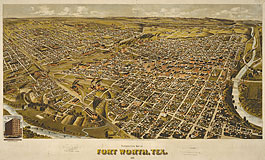
In terms of “antique prints,” the museum’s collection related to “Western Americana” is as good as any in the country. Included are prints from all the major series of Indian portraits (Bodmer, Catlin, McKenney & Hall, J.O. Lewis), as well as prints from major explorations, and landscapes and genre scenes of the American West, including bird’s eye views. Such views of Texas locations is the subject of a wonderful, on-line exhibition. While this is probably the Amon Carter’s particular strength in terms of antique prints, it has many others, including prints by John James Audubon, American historical prints, a terrific collection of Currier & Ives prints, and views of other parts of the country (for instance a set of the Hudson River Portfolio)

The Amon Carter’s collections are accessible to some extent through their web site (such as the Texas views exhibit), in their regular exhibitions, through their many scholarly catalogues, and for researchers who can view prints in person with an appointment. The prints collection continues to grow through acquisitions and through gifts, especially via the Amon Carter Print Guild support group. There is a dedicated area of the museum for print exhibits and an exhibition of the museum’s antique Western American prints will open this autumn. Given the quality of the collections and the history of excellence from the Amon Carter, this exhibition should be well worth seeing!

Coming soon, a profile of the director of the Amon Carter, print expert Ron Tyler…

Lithographic prints

In previous blogs, I talked about two types of original prints, relief prints and intaglio prints. Today I'll talk about the third major type of original print, planographic prints.

Whereas a relief print has its image printed from a raised surface, and an intaglio print has its image printed from a recessed image, a planographic print has its image printed from a flat surface. Because the matrix is not physically modified to hold the ink, the process depends upon a chemical reaction. For antique prints, the only planographic original prints are lithographs.

A lithograph is created by drawing an image onto a stone (lithography = “stone-drawing”) or metal plate using a grease crayon or a greasy ink called tusche. The process is based on the principle that grease and water do not mix. To create a lithograph, the stone or plate is washed with water--which is repelled by the crayon--and then with ink--which is absorbed by the crayon. The image is printed onto the paper from the stone or plate, which can be re-inked many times without wear.

As the process is planographic, no platemark is created when a lithograph is printed. While zinc plates were used late in the nineteenth century, most antique lithographs are printed from Bavarian limestone (other types of limestone were tried, but that from Bavaria works the best). The tuche holds to the stone in a pattern that follows the grain of the stone, so an examination of a lithographic image under magnification shows that stone grain (this is the way one can distinguish an original lithograph from a collotype, which is a planographic process but shows the pattern of the photographic gelatin used to create the image).

Lithography was invented by Alois Senefelder in 1798 but didn’t come into general use until the 1820s. After that time lithography quickly replaced intaglio processes for most illustrative and commercial applications, for the design was easier to apply to the stone or plate, it was much easier to rework or correct a design, and many more images could be produced without loss of quality than in any of the intaglio processes.

Most lithographs are printed with a black or sepia ink, and many were issued that are hand colored. A tinted lithograph is a lithograph whose image is printed from one stone and which has wash color for tinting applied from one or two other stones. Sometimes, hand highlight color is added to a tinted lithograph. A chromolithograph is a colored lithograph, with at least three colors, in which each color is printed from a separate stone and where the image is composed from those colors. I'll post a blog specifically on chromolithographs in the near future.

(Feel free to browse here for more information on Famous Lithographers)

Friday, May 22, 2009

American Art Union

In the future I will be posting blogs on current print organizations, but this blog concerns a group that disappeared over a century and a half ago...

The American Art Union (1839-1851) was an organization created to support contemporary American art and to develop a popular appreciation of it by the American middle class. In 1838, James Herring opened his Apollo Gallery in New York City, as a venue for the display and sale of American art. Herring felt that American pubic needed to be exposed to and enlightened about American art, both for their personal and social improvement, but also to support struggling American artists. Hearing of the Edinburgh Association for the Promotion of Fine Arts, as well as other art unions that had been formed in Europe earlier in the decade, in 1839 Herring decided to form an art union, which he named the “Apollo Association for the Promotion of the Fine Arts in the United States.” It was renamed the following year as the American Art Union.

Similarly to the European art unions, individuals could join the AAU for a small membership fee, and these funds were used to purchase and commission original paintings from American artists, as well as to produce engravings from these works to be distributed to the membership. Members were entitled to receive an annual members’ engravings, as well as a chance in a lottery of paintings and prints purchased by the AAU for this purpose. The association also held a continuing exhibit of American art at its “perpetual free gallery.” While the union had a rocky start, it expanded greatly, increasing to almost 19,000 subscribers in 1849. However, within two years it was forced to fold.

The AAU is best known today for the thirty-six engravings it published based on the paintings of some of the most luminous names in American art, e.g. George Caleb Bingham, Thomas Cole, F.O.C. Darley, Asher B. Durand, and William Sidney Mount. The association is especially important for the seminal role it played in stimulating American art and for spreading an awareness of this art throughout the country. With its gallery and thousands of subscribers, the AAU probably had more to do than any other force with the success of many of America’s nineteenth century artists and the popularization of their work. The legacy of the American Art Union is immense and its prints are an important part of that.

John Blake White. "Gen. Marion in his swamp encampment inviting a British Officer to dinner." 1840. 16 5/8 x 20 3/8. Mezzotint by John Sartain. The first of the annual subscription prints, issued when the organization was still the Apollo Association. The "Swamp Fox" extends courtesy to an enemy officer.

Richard Caton Woodville. "Mexican News." 1851. 20 1/x x 18 1/2. Engraving by Alfred Jones. Woodville has captured a scene of American life, as news of the Mexican war is read to townsfolk on the porch of a hotel.

William Sidney Mount. "Bargaining for a Horse." 1851. 7 3/4 x 10. Engraving by Charles Burt. The AAU's version of Mount's famous barnyard scene, also issued as a lithograph, "Coming to the Point," four years later.

George Caleb Bingham. “The Jolly Flat Boat Men.” 1852. 18 1/2 x 24. Mixed engraving by T. Doney. Probably the most famous engraving issued by the AAU, this is a superb example of the work of Bingham, whose genre scenes present a quintessential picture of American life in the nineteenth century.

Thursday, May 21, 2009

Wendy Jane Shadwell

In this blog I will, from time to time, profile various influential people involved with antique prints. Most will be living individuals, but in light of the recent announcement of a bequest made at the American Historical Print Collectors Society (AHPCS), this profile is of a wonderful person no long with us.

The print world lost a good friend and eminent scholar when Wendy Shadwell died after a long battle with cancer on October 23, 2007. However, her influential legacy continues through her extensive writings, many friends, and her generous gift to the AHPCS.

Wendy received her BA with honors from the University of Mary Washington in 1963, followed by graduate studies in art history at Columbia. After this, Wendy became the curator for J. William Middendorf’s important collection of art, which included many American historical prints. Later Wendy moved on to the New York Historical Society, where she became curator of prints from 1974 until her retirement in 2002. The NYHS’s collection of prints, photographs, drawings and ephemera, numbering approximately three million items, is one of the most significant such collections in the country and it was well looked after, catalogued and augmented by Wendy.

Wendy believed strongly in spreading the word about antique prints and she wrote extensively on the subject. Among her publications was the influential book, American Printmaking: The First 150 Years, featuring the prints from the Middendorf collection, as well as numerous articles in scholarly publications, including many in the AHPCS journal, Imprint. Over the years, Wendy lectured extensively on antique prints and also brought historical prints to the notice of the public by curating many exhibitions of the NYHS’s holdings.

She was a member of a number of professional organizations, including the Print Council of America and the AHPCS, where she served for many years as board member and president from 1998 to 2001. Wendy felt a strong attachment to the AHPCS, which shared her goals of the study of historical prints and helping to spread knowledge on the topic to scholars and the general public. It was to help achieve those ends that Wendy Shadwell left an incredibly generous bequest to the AHPCS, which has received $175,000 (!) from her estate. The AHPCS board will be carefully studying how to use these funds to achieve the goals shared by the organization and Wendy, and to honor her memory. Wendy was a friend and scholar who graced the world of prints for many years; her legacy will be with us in our memories, her writings, and now through the ability of the AHPCS to use her bequest to help spread the gospel.

Wednesday, May 20, 2009

Curious Case of Benjamin Button

I watched "The Curious Case of Benjamin Button" last night and was pleased to see quite a number of antique prints hanging in various rooms. The prints were all used, I think, appropriately for what would likely have appeared on walls in the periods depicted. There were some nice (though probably acidic) etching revival, landscape prints hanging on the wall of one of the guest rooms in New Orleans. Also a striking Piranesi print hanging in the Mr. Button's office. Finally, a colorful Gould hummingbird print actually had symbolic meaning in the movie. It appears in a hotel room scene and it visually references the story of the hummingbird that the tugboat captain (who just previously had died) had told in the bar in Moscow. A live hummingbird appears a couple of other times, but here the director used an antique print to carry on the theme. All the prints in the movie did look to be originals, which is not always the case....